Red Light for Skin: What the Dermatology Evidence Actually Supports
Red light’s skin claims run from collagen miracle to expensive placebo — and the dermatology literature sits in between: real-but-modest effects, dose-dependent, patience-required. The skin evidence review: what’s supported, what devices deliver and where it fits.

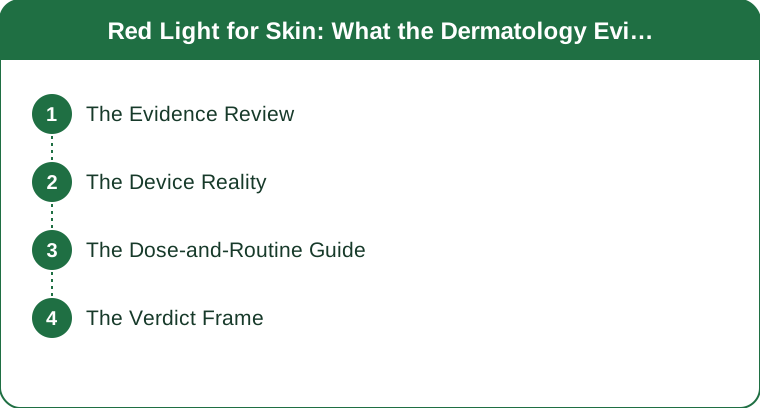
The Evidence Review
What studies support: the collagen-and-wrinkle findings (the red-and-near-infrared trials showing modest improvements in fine lines and skin texture — the photobiomodulation mechanism: the mitochondrial stimulation hypothesis; the effects real and REASONABLE, not transformative per the honest-review doctrine), the acne evidence (the blue-red combinations with genuine trial support — the inflammatory-acne tier; the dermatologist-adjunct framing), the wound-and-redness signals (the healing-support studies — the post-procedure use in clinics; the rosacea-adjacent calming reports being weaker evidence), the hair-growth note (the red-light devices with FDA-cleared hair claims — the modest-density evidence for pattern thinning per the hair doctrine), and the honest limits (the deep-wrinkle and sagging tiers unmoved — the sunscreen-and-retinoid foundations from the respective doctrines outperforming any light; the red light as the supporting cast, never the lead).
The Device Reality
What home devices deliver: the clinic-versus-home gap (the professional panels at higher irradiance — the home devices delivering less per minute; the longer-sessions compensation math), the mask-versus-panel choice (the LED masks’ convenience and fit versus the panels’ power and coverage — the consistency argument favoring whichever gets used per the adherence doctrine), the spec literacy (the wavelength check — the 630-680nm red and 800-880nm near-infrared being the studied bands; the irradiance numbers read skeptically: the marketing inflation being routine), the price-versus-evidence honesty (the 100-300 dollar tier delivering the studied wavelengths — the four-figure devices buying coverage-and-power, not different physics per the budget doctrine), the safety profile (the eye protection with panels — the generally-excellent safety record; the medication-photosensitivity and condition checks per the medical doctrine), and the red-flag marketing (the detox-and-cellulite claims from the honest-wellness doctrine — the device sold on studied claims being the buyable one).

The Dose-and-Routine Guide
Using it right: the consistency requirement (the studies using multiple weekly sessions across MONTHS — the three-five weekly 10-20 minute standard; the sporadic use producing sporadic nothing per the consistency doctrine), the distance-and-time factors (the device instructions honored — the closer-and-longer variables; the more-is-better ceiling: the studied doses being moderate), the routine placement (the clean bare skin — the light before the skincare layers; the evening-session convenience pairing with the wind-down per the evening doctrine), the timeline calibration (the 8-12 week judgment window — the monthly photos from the tracking doctrine; the subtle-improvement expectations set in advance), the combination strategy (the red light BESIDE the proven pillars — the sunscreen, retinoid and sleep from the respective doctrines; the light added to a working routine, not replacing one), and the stop-conditions (the irritation or flare responses — the sensitive-skin gradual entry per the sensitivity doctrine).
The Verdict Frame
The honest bottom line: the who-benefits profile (the fine-lines-and-texture goals with realistic expectations — the acne-adjunct users; the already-doing-the-basics population adding a marginal layer), the who-should-skip list (the basics-not-yet-done population — the sunscreen-less buyer better served by SPF per the priority doctrine; the miracle-seekers destined for disappointment), the money math (the device cost against the professional-treatment alternatives — the home red light being the budget tier of light-based care; the cost-per-session across a year of use), the placebo-and-ritual honesty (the routine’s relaxation value counting — the ten quiet minutes being wellness regardless per the ritual doctrine), and the closing calibration (the red light as a B-minus tool with an A-plus marketing department — the modest real effects, patiently collected, on top of fundamentals; the evidence, followed exactly as far as it goes). Studied wavelengths, three-plus weekly sessions, judged at twelve weeks: the light, honestly dosed.
The dermatology evidence supports modest fine-line, texture and acne benefits — at 630-680nm red, three-five weekly sessions for months, judged by photos at twelve weeks. It’s a supporting layer on top of sunscreen and retinoids, never the lead; skip four-figure devices.
Keep Reading
This article is for general informational purposes only and is not medical advice. Always consult a qualified health professional for guidance specific to you.