Why the Time of Day You Use Red Light Changes What It Does
Quick Answer: Red and near-infrared light has two separate effects: a local tissue effect at the treated area, and a systemic effect on the body clock through light exposure. The local effect works at any hour. The circadian effect does not — bright light exposure in the evening can influence alertness and sleep timing, and morning exposure works with your rhythm rather than against it. If you are using a panel for skin or tissue, timing matters less than consistency. If you are using one late at night and sleeping badly, the timing may be the reason.
You have been careful about the distance and the minutes. You use it at eleven at night because that is when you have time.
That last detail may be the one that matters.

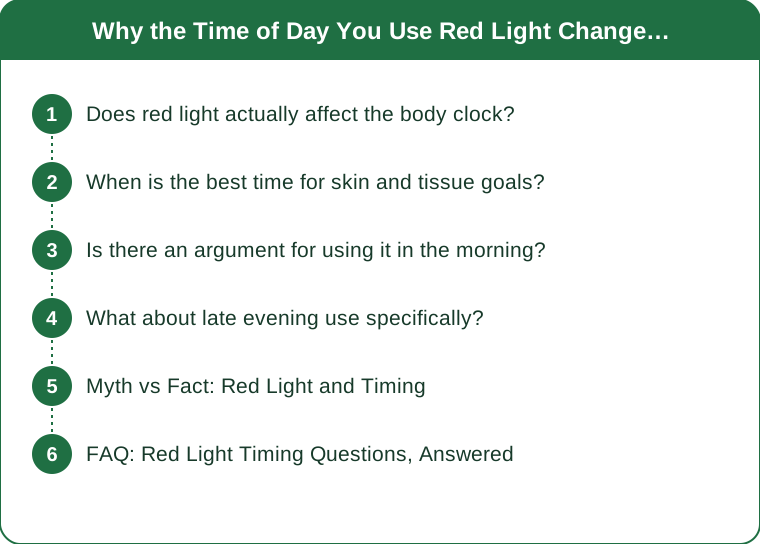
Does red light actually affect the body clock?
Less than blue light does, and more than zero, and the difference between those two statements is where the confusion lives.
The body clock is set primarily by specialised cells in the retina that are most sensitive to blue wavelengths around 480 nanometres. Red light at 630 to 660 nanometres is far less effective at shifting the clock, which is exactly why red-tinted evening lighting is recommended over white light.
But less effective is not the same as ineffective, particularly when the source is a high-output panel a short distance from your face. A panel producing enough light for a therapeutic tissue dose is a substantial amount of light, and some of it reaches the eyes even when you are not looking at it directly. The evidence on whether that meaningfully shifts human circadian timing is not settled, and the practical experience of a fair number of users — that a late high-intensity session leaves them alert — is at least consistent with an effect.
There is a second, less discussed pathway. Red and near-infrared light influences mitochondrial activity in the treated tissue, and one plausible consequence of increasing cellular energy production is a short-term alertness effect that has nothing to do with the retina at all.
The honest position: the local skin and tissue effects are reasonably well studied, and the systemic timing effects are much less so. If you sleep well and use a panel late, there is no strong reason to change. If you sleep badly and use a panel late, the panel is an obvious variable to test.
When is the best time for skin and tissue goals?
For purely local effects, consistency beats timing by a wide margin.
The skin and tissue response to red light is a local one, driven by the amount of light delivered to that tissue. The tissue does not know what time it is in any way that has been shown to matter for collagen or wound-healing outcomes. A session at seven in the morning and a session at seven in the evening deliver the same dose to the same skin.
What does matter is doing it at all, repeatedly, for months. Visible skin results from red light are slow — most protocols in the literature run for eight to twelve weeks before assessing — and the single biggest determinant of whether someone sees anything is whether they were still doing it in week ten.
Which makes the correct timing question a behavioural one. Attach the session to something you already do without fail. After brushing your teeth, before your shower, while the coffee brews. The people who succeed with red light are the ones who stopped choosing a time each day.
There is one skincare-specific timing consideration worth knowing. If you use a retinoid or acids, apply them after the light session rather than before, and on clean skin. Not because the light degrades them in any dramatic way, but because a clean, product-free surface is the condition most protocols assume, and layering an active under a warm panel is a reasonable way to increase irritation.
Is there an argument for using it in the morning?
Yes, and it is stronger for the people using it for energy, mood or recovery than for the ones using it for skin.
Morning light exposure of any kind supports circadian alignment, and a bright panel in front of your face at seven is a light exposure whether or not you intended it to be one. For people with sluggish mornings, particularly in autumn when natural morning light gets scarce, this is a genuine secondary benefit that costs nothing.
It also solves the compliance problem. Morning routines are more stable than evening ones for most people. Evening sessions are the first thing cancelled by a late meal, a social event or simple tiredness.
For athletic recovery, the evidence points more toward proximity to training than to time of day. Sessions before training have been studied for performance effects, sessions after for recovery, and the results in both cases are mixed and modest. If you train in the morning and use the panel after, that is a defensible protocol regardless of the clock.
There is a caveat for morning use that people rarely mention. A red panel is not a substitute for outdoor morning light if circadian alignment is your goal — outdoor light, even on an overcast autumn day, is many times brighter than any home panel and contains the blue wavelengths that actually set the clock. Ten minutes outside does more for your body clock than any panel will.

What about late evening use specifically?
It is the only timing that carries a plausible downside, and the fix is straightforward if you want to keep it.
The concern is straightforward: a high-output light source close to your face within an hour or two of bed, in a body that is trying to wind down. Even at wavelengths that affect the clock weakly, intensity and proximity matter, and a panel is both intense and close.
If evening is the only time you will realistically use it, several things reduce the risk. Move the session earlier in the evening — before dinner rather than before bed — which preserves the habit and puts distance between the light and sleep. Wear the supplied eye protection, which reduces retinal exposure specifically. Treat body areas rather than the face where possible, since a panel aimed at a knee or a shoulder puts far less light near your eyes than one aimed at your face.
And run the obvious test rather than speculating. Two weeks of evening sessions, two weeks of morning sessions, and pay attention to how you sleep. You have one subject and the effect, if it exists for you, should be noticeable within that time.
A note on eye safety generally, which applies at every hour: do not look directly into a panel, use the protection that comes with it, and take particular care if you have any retinal condition or take photosensitising medication. Several common medications increase light sensitivity. This is general information, not medical advice — check with a pharmacist if you take anything regularly.
Myth vs Fact: Red Light and Timing
Myth: Red light cannot affect sleep because it is not blue light.
Fact: Red light affects the circadian system far less efficiently than blue, and a high-intensity source at close range is not a small exposure. The relevant comparison is not red versus blue but a dim red bulb versus a therapeutic panel, and those are very different amounts of light.
Myth: Morning sessions work better for skin.
Fact: There is no good evidence for a time-of-day effect on the local skin response. The morning advantage is about adherence and about the incidental benefit of morning light exposure, not about the skin itself.
Myth: Using it right before bed helps you sleep.
Fact: This appears in a lot of marketing and rests on thin ground. Some small studies suggest possible sleep benefits from red light exposure, and others find alerting effects. The most honest statement is that it varies between people, which means testing on yourself is more informative than reading claims.
Myth: More sessions per day speeds up results.
Fact: The dose response for photobiomodulation is biphasic — there is a window where more is better, above which additional exposure does less rather than more. Twice-daily sessions are not obviously better than once, and in some protocols they may be worse. Following the manufacturer’s stated protocol is more sensible than doubling it.
Myth: You should feel something during a session.
Fact: Mild warmth is normal from near-infrared. Anything beyond gentle warmth suggests you are too close, and the sensation is not an indicator of effectiveness in either direction.
FAQ: Red Light Timing Questions, Answered
How long before bed should I stop using a panel?
There is no established number. A practical starting point is finishing at least two hours before bed and seeing whether it makes a difference to your sleep, then adjusting. If it makes no difference for you, the constraint does not apply.
Does it matter whether I use it before or after skincare?
After cleansing and before applying products is the usual sequence, mainly because most protocols study bare skin and because some active ingredients under warmth increase irritation. It is a sensible default rather than a strict rule.
Is it better before or after a workout?
Before has been studied for potential performance effects and after for recovery, with modest and inconsistent findings for both. If you have to pick, after is the more common protocol and fits more easily into a routine.
Can I use it in a bright room?
Yes for the local tissue effect, which depends on the light reaching the skin rather than on ambient conditions. A dim room simply makes the panel feel more intense; it does not change the dose delivered.
Does autumn change anything about how I should use it?
Only through the daylight side. As natural morning light gets scarcer, a morning session becomes a slightly more attractive slot, but it remains a poor substitute for actually going outside. If your mood drops seasonally, that is worth raising with a professional rather than solving with a skincare device.
How long until I see anything?
Most skin protocols in the literature run eight to twelve weeks with several sessions per week before assessing outcomes. Anything faster than that is likely to be hydration or temporary flushing rather than a durable change.
TL;DR:
- Red light has a local tissue effect that works at any hour and a much weaker systemic light effect that does not.
- For skin goals, consistency across eight to twelve weeks matters far more than the time of day.
- Morning sessions win on adherence and on incidental light exposure — but ten minutes outdoors beats any panel for your body clock.
- Late-evening face sessions are the one timing with a plausible downside; move them earlier, use eye protection, or test it on yourself for two weeks.
- More sessions per day is not better — the dose response has a ceiling.
Pick a fixed slot you already never miss and attach the session to it, rather than choosing a time each day. This is general information, not medical advice.
Keep Reading
This article is for general informational purposes only and is not medical advice. Always consult a qualified health professional for guidance specific to you.