Why People Start Red Light Sessions in Autumn, and What That Changes
Quick Answer: Autumn drives red light purchases for two different reasons that get blurred together. One is skin and recovery, which is what red and near-infrared photobiomodulation is actually studied for. The other is low mood and low energy from reduced daylight, which is what bright white light boxes are used for and which red panels are not designed to address. They are different devices for different problems, and buying the wrong one is the most common and most expensive mistake in this space.
If the goal is mood in a dark winter, the relevant device is not a red panel.
Here is what each is for and how to run a sensible routine.

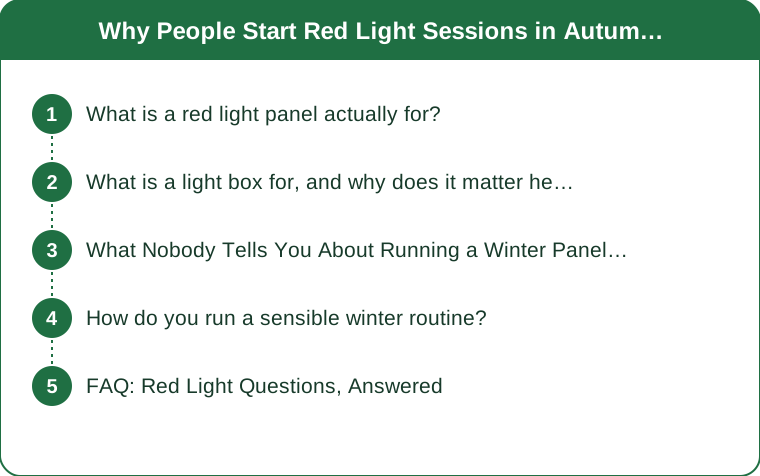
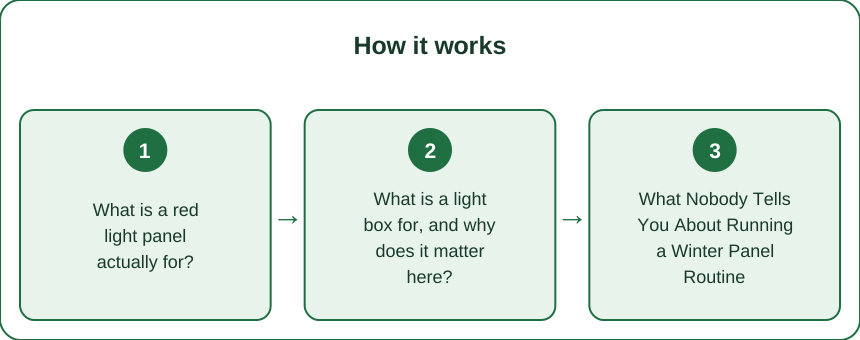
What is a red light panel actually for?
Photobiomodulation uses specific wavelengths, typically red around 630 to 660 nanometres and near-infrared around 810 to 850, absorbed by cells in ways that are the subject of ongoing research, with the most consistent findings in skin and in localised musculoskeletal applications.
Skin applications are the best-supported area. Studies have looked at collagen, wound healing and various skin quality measures, with results that are generally encouraging and vary considerably by protocol.
Musculoskeletal use is the second area. Localised application for muscle soreness and joint discomfort, again with variable protocols and mixed evidence quality.
Dose matters and is easy to get wrong. There appears to be a range where these devices do something and both under-dosing and over-dosing produce less effect, which makes distance and duration genuine variables rather than details.
Distance from the panel changes the dose dramatically. Irradiance falls off sharply with distance, so doubling your distance reduces the dose by considerably more than half. This is the single most common protocol error.
And these are not circadian devices. Red light is specifically the part of the spectrum that has the least effect on the circadian system, which is why it is often recommended for evening use.
What is a light box for, and why does it matter here?
Bright light therapy for seasonal low mood uses broad-spectrum white light at high intensity, typically around 10,000 lux, used in the morning for a set duration.
The mechanism is circadian, and it depends on blue-wavelength content, which is exactly what red panels deliberately lack.
Timing is central. Morning use is standard for the seasonal application, whereas red light panels have no equivalent timing requirement.
So a red panel will not do what a light box does, and this is worth being clear about before spending money on the wrong category.
Getting outside in the morning is the free version of the light box. Even an overcast morning outdoors delivers far more light than a well-lit indoor room, and a twenty-minute morning walk is the most cost-effective intervention available for winter light exposure.
And seasonal low mood is a medical matter worth discussing with a doctor, particularly if it affects daily functioning. Light therapy is not appropriate for everyone, including some people on photosensitising medication or with certain eye conditions. This is general information, not medical advice.

What Nobody Tells You About Running a Winter Panel Routine
Consistency matters more than session length. Protocols in the research are typically several sessions a week over weeks to months, not occasional long sessions. A shorter routine you actually do beats a longer one you abandon in November.
Distance is the variable everyone gets wrong. Manufacturers specify irradiance at a given distance, and sitting twice as far away changes your dose far more than people expect. Measure it once and mark the spot on the floor.
Panels degrade over time. LED output declines with hours of use, so a panel three years into daily use is delivering less than it did, and nothing about it looks different.
Treated area is smaller than it looks. The useful irradiance zone is generally narrower than the panel’s physical size, so a small panel treats a small area, and rotating body areas across sessions is more realistic than expecting whole-body coverage.
Eye protection is worth taking seriously, particularly with near-infrared, which you cannot see and therefore cannot judge by brightness. Follow the manufacturer’s guidance rather than your own comfort.
More is not better. The dose-response relationship in this area does not appear to be linear, and longer sessions are not automatically more effective.
And the market is largely unregulated in terms of claims. Specifications are inconsistently reported, and third-party measurement is rare, so treat marketing numbers with appropriate caution.
How do you run a sensible winter routine?
Decide which problem you are solving first. Skin and localised recovery is one device. Winter mood and energy is a different one, or ideally morning daylight.
Get outside in the morning regardless. It is free, it addresses the circadian side, and it is the intervention with the best cost-benefit ratio in this entire article.
Set the distance the manufacturer specifies and mark it. Then keep it constant so your sessions are comparable.
Keep sessions short and frequent rather than long and occasional, in line with typical study protocols.
Pick one or two target areas rather than trying to treat everything, given realistic panel coverage.
Use it in the evening if you like, since red wavelengths have minimal circadian effect, which makes it one of the few light-based routines that does not interfere with sleep.
Give it eight to twelve weeks before judging skin outcomes, since that is roughly the timescale the studies work on.
And talk to a doctor before starting if you take photosensitising medication, have an eye condition, are pregnant, or have any skin condition under treatment. This is general information, not medical advice.
FAQ: Red Light Questions, Answered
Will a red light panel help with winter low mood?
It is not designed for that. Bright broad-spectrum light boxes and morning daylight address the circadian mechanism; red wavelengths largely do not.
How far should I sit from the panel?
At the distance the manufacturer specifies irradiance for. Irradiance falls off sharply with distance, so this is the most consequential setting.
Is longer better?
No. The dose-response relationship does not appear to be linear, and over-dosing appears to reduce rather than increase the effect.
Do I need eye protection?
Follow the manufacturer’s guidance, and take near-infrared seriously since you cannot see it and cannot judge exposure by brightness.
How long before I see anything?
Studies on skin outcomes generally run over weeks to months. Eight to twelve weeks of consistent use is a reasonable window before judging.
Can I use it in the evening?
Yes. Red wavelengths have minimal circadian impact, which makes evening use one of the practical advantages of this category.
Does the panel wear out?
LED output declines with use over years, and nothing about the panel looks different as it does.
TL;DR:
- Red light panels and bright light boxes solve different problems; autumn buyers frequently conflate them.
- Red and near-infrared photobiomodulation is best supported for skin and localised musculoskeletal use.
- Distance from the panel is the most consequential and most commonly wrong setting.
- Short, frequent sessions match study protocols better than long occasional ones.
- For winter mood and energy, morning daylight or a bright light box is the relevant intervention.
- Panels degrade with use, and marketing specifications in this market are inconsistently reported.
Decide which problem you are buying for. The two devices are not interchangeable.
Keep Reading
This article is for general informational purposes only and is not medical advice. Always consult a qualified health professional for guidance specific to you.