Why Your Red Light Panel Gets Weaker Every Year
Quick Answer: LEDs do not fail suddenly — they dim gradually, typically rated to reach 70% of original output (L70) somewhere between 25,000 and 50,000 hours. Heat accelerates it, and cheap panels with poor thermal management degrade far faster than their ratings suggest. At 20 minutes a day, a panel with weak cooling can lose a meaningful share of its output within three to five years, silently lengthening the session you would need for the same dose.
You bought it, worked out the right distance, settled on ten minutes, and built a habit.
Three years later the routine is identical and the results feel flatter, and the obvious suspects — consistency, skin, expectations — all check out.
The panel is a consumable. Nobody tells you that at the point of sale, and it changes how you should think about dose over time.

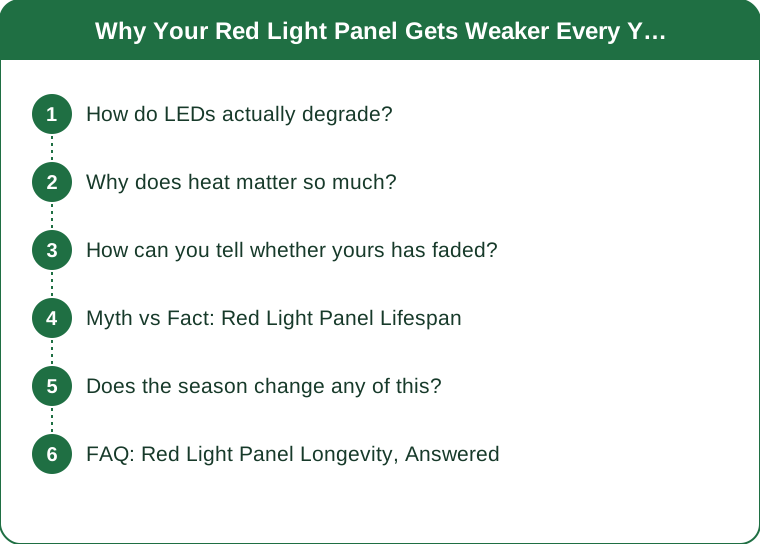
How do LEDs actually degrade?
Not by burning out — by getting quietly dimmer.
The industry measure is L70: the number of operating hours until an LED produces 70% of its initial output. Quality LEDs are commonly rated at 25,000 to 50,000 hours to L70. That sounds enormous, and under ideal conditions it is.
Degradation happens through several mechanisms — gradual damage to the semiconductor structure, yellowing of the encapsulant, and degradation of the phosphor and reflector materials. All of them are accelerated by heat.
Two important details:
- It is gradual and continuous. There is no point at which you notice a change. Your eye also adapts, and eyes are poor absolute light meters.
- The rating assumes ideal thermal conditions. A well-cooled LED at its rated current may exceed the figure. The same LED run hot and hard can fall short by a wide margin.
Since red light dose is irradiance multiplied by time, a panel that has lost output silently reduces the dose of a session you have not changed.
Why does heat matter so much?
Because thermal management is the single biggest difference between panels that hold output and panels that do not.
An LED converts a substantial part of its input power into heat. That heat must be conducted away — through the board, into a heatsink, and out via fins or a fan. If it is not, junction temperature rises, and both efficiency and lifespan fall sharply.
Practical signs of a panel with weak thermal design:
- It gets genuinely hot to the touch on the back or frame after a session.
- There is no fan and no substantial metal heatsink — just a plastic housing.
- Output is claimed to be very high for the size and price. High irradiance from a small, passively cooled panel means high thermal load.
- The panel is run in a warm, unventilated room — which makes any panel’s cooling less effective.
The compounding problem: a panel running hot degrades faster, and as it degrades some users increase session length, which increases total operating hours, which accelerates degradation further.
How can you tell whether yours has faded?
Without a meter you cannot measure it precisely, but you can bound it.
Count your hours. Sessions per week × minutes × weeks gives you total operating hours. Twenty minutes a day is about 120 hours a year. Against a 30,000-hour rating that is trivial; against a poorly cooled panel’s real-world behaviour it is less trivial than it looks.
Compare against a known reference. If you have access to a second panel, or a friend’s, a phone camera light meter app is not accurate in absolute terms but can compare two sources under the same conditions reasonably.
Watch for uneven fade. LEDs nearest the hottest part of the board degrade fastest. Visible unevenness across the array is a strong signal.
Check the warranty terms. Manufacturers who are confident about thermal design usually offer longer warranties. A one-year warranty on a large panel is informative.
The honest position: for most quality panels used domestically, degradation over five years is real but modest. For inexpensive, passively cooled panels used daily in a warm room, it can be substantial.

Myth vs Fact: Red Light Panel Lifespan
Myth: LEDs last 50,000 hours, so a home panel lasts a lifetime. Fact: the rating is to 70% output, not to failure, and it assumes ideal thermal conditions rarely met in cheap consumer housings.
Myth: If it still looks bright, the dose is the same. Fact: human vision is logarithmic and adapts constantly. A 30% drop in output is essentially invisible to the eye.
Myth: Running it longer compensates for fading. Fact: it does compensate for dose arithmetically, but it also adds operating hours and heat, accelerating the problem. Reducing distance is the more efficient correction, since irradiance falls off sharply with distance.
Myth: All the LEDs fail at once when it goes. Fact: individual LED failures are visible and obvious. The gradual, invisible dimming across all of them is the thing that actually affects your dose.
Does the season change any of this?
It does, through room temperature and through usage patterns.
Winter usage rises. Home red light use goes up as daylight falls — more indoor time, more attention to skin and to mood, more sessions. That means more operating hours in the darker months than the bright ones.
Heated rooms run hotter. A panel used in a room at 22°C with the heating on cools less effectively than the same panel in a 17°C room. Over a winter of daily use, that is a meaningful thermal difference.
Cold rooms are actually kinder. A panel in a cool utility room or garage will run cooler and degrade more slowly, all else equal — though comfort during a session obviously matters too.
Practical seasonal adjustments:
- Give the panel 30cm of clear space behind and above it so convection can work.
- Do not stand it against a radiator or in a cupboard.
- If it has a fan, check the vents for dust before the heavy-use season starts.
- Keep a note of when you bought it. Three years of winters is a lot more hours than three years of summers.
FAQ: Red Light Panel Longevity, Answered
Should I replace my panel after a certain number of years?
There is no fixed number. Track hours rather than years, keep the panel cool, and reassess if results plateau after a long period of genuine consistency.
Can I just move closer to compensate?
Yes, and it is the most efficient correction — irradiance falls off steeply with distance, so a modest reduction meaningfully raises dose. Follow the manufacturer’s minimum distance, particularly regarding heat and eye safety.
Do bulbs or panels differ in how they age?
Panels using higher-quality LEDs with proper heatsinking and active cooling hold output far better. Thermal design is the single most predictive factor, and it is rarely mentioned in marketing.
This is general information, not medical advice. Follow your device’s eye-protection guidance, which varies meaningfully between devices.
TL;DR:
- LEDs dim gradually rather than failing — L70 ratings of 25,000 to 50,000 hours assume ideal cooling that consumer panels often do not provide.
- Heat is the accelerant; a hot-running, passively cooled panel degrades far faster than its rating suggests.
- Fading is invisible to the eye, so track operating hours and watch for uneven output across the array.
- Winter raises usage and room temperature together — give the panel clearance, keep vents clean, and correct dose by reducing distance rather than extending sessions.
Your routine has not stopped working. The equipment has been slowly changing the dose underneath it, and it is the one variable nobody puts on the checklist.
Keep Reading
This article is for general informational purposes only and is not medical advice. Always consult a qualified health professional for guidance specific to you.