Why Doing Two Red Light Sessions a Day Does Not Double Anything
Quick Answer: Red light therapy follows what researchers call a biphasic dose response - benefit rises with dose up to a point, then plateaus and can decline with more. Doubling daily sessions does not double the effect and may put you past the peak. Most protocols in the literature use one session per area per day, or every other day, with rest days built in. If you want a bigger result, extend the number of weeks rather than the number of sessions per day.
The logic feels sound: if ten minutes helps, twenty should help twice as much.
That is exactly the assumption the dose-response curve does not support.

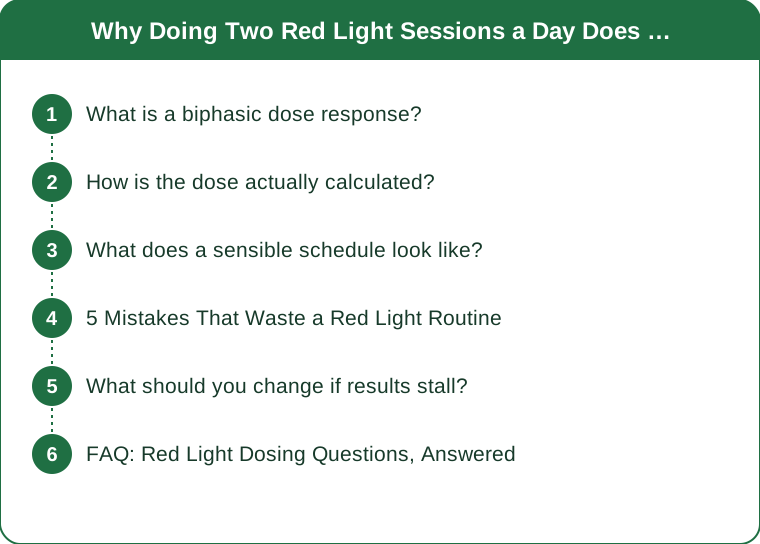
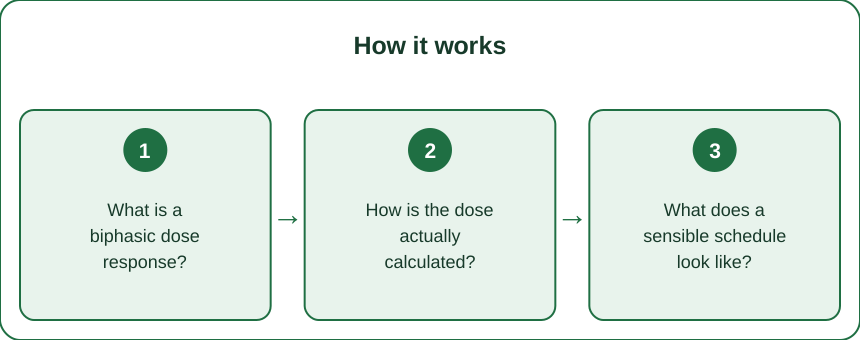
What is a biphasic dose response?
It means the curve rises, peaks, and then falls, rather than climbing indefinitely. Low doses do little, a middle range produces the effect, and higher doses produce less than the middle range did.
This is well documented in the photobiomodulation literature and is one of the most commonly cited reasons results vary so much between users and studies.
The proposed mechanism involves cellular energy pathways responding favourably to a moderate light dose and less favourably - or not at all - once that is exceeded.
It means an under-dose and an over-dose can look identical from the outside: nothing much happens either way.
Which is why people who add sessions after a disappointing month sometimes get worse results, and reasonably conclude the whole thing does not work.
And it makes total dose the number that matters, not session count. Dose is irradiance multiplied by time, which means distance from the panel is doing as much work as the clock.
How is the dose actually calculated?
Dose equals irradiance times time. Irradiance - the power arriving per unit area, usually given in milliwatts per square centimetre - is set by the panel and, critically, by your distance from it.
Distance changes irradiance sharply. Moving from six inches to twelve inches away can cut the delivered power by a large fraction, which means the same ten-minute session is a completely different dose at a different distance.
So doubling session length at close range overshoots more easily than at long range. The person most likely to exceed the useful window is the person sitting closest.
Manufacturer irradiance figures are frequently measured under favourable conditions and are difficult to compare between brands, which makes precise dosing at home genuinely hard.
Which is an argument for consistency rather than intensity. Pick a distance, pick a time, and keep both fixed so the variable you are testing is weeks, not settings.
And note that the treated area is smaller than the panel looks. Effective coverage falls off toward the edges, so a second session often re-treats the same central patch rather than adding area.
What does a sensible schedule look like?
One session per target area per day is the common structure across published protocols, and many use three to five days a week rather than seven.
Rest days appear deliberately in study designs, which suggests they are part of how the effect is meant to accumulate rather than an inconvenience.
Session lengths in the ten to twenty minute range per area are typical at consumer panel distances, though this varies enormously with the specific device.
Consistency over eight to twelve weeks is where results appear in most of the skin and recovery literature - not in the first fortnight.
If you treat multiple areas, that is what adds total time, not repeating the same area twice.
Splitting a session into two shorter ones is different from doing two full sessions, and is a reasonable way to fit it into a day if the total dose stays the same.
And if you have missed a week, do not compensate with double sessions. Resume the normal schedule. This is general information, not medical advice.
5 Mistakes That Waste a Red Light Routine
Adding sessions instead of adding weeks. The single most common response to slow results, and the one most likely to move you past the peak of the dose curve. Results in the literature come from consistency over months.
Changing distance without changing time. Moving closer for a better session silently multiplies the dose. If you change distance, you have changed the protocol - and you no longer know what you are testing.
Treating through clothing or over product. Fabric blocks a substantial share of the light, and anything opaque on the skin does the same. Sitting closer to compensate is guesswork stacked on guesswork.
Assuming warmth means it is working. Panel warmth comes largely from the device, and the therapeutic wavelengths are not meant to heat tissue meaningfully. Heat is a poor proxy for dose and encourages backing away, which lowers the dose you were trying to deliver.
Changing three variables at once after a disappointing month. New distance, longer sessions and a second daily session together mean the next month teaches you nothing. Change one thing, hold it for six to eight weeks, then judge.
What should you change if results stall?
Extend the timeline first. Eight to twelve weeks of consistent use is the realistic window for visible skin changes in most protocols.
Check your distance against the manufacturer’s stated figure and fix it with a mark on the floor so it stops drifting.
Confirm you are treating bare, clean skin, since sunscreen, makeup and heavy moisturiser all sit between the panel and the target.
Reduce rather than increase if you have been going long and close. Overshooting looks exactly like under-dosing from the user’s side.
Treat fewer areas properly rather than many areas briefly, since partial coverage at the panel edges delivers much less than the centre.
Track with photos in fixed lighting every four weeks, because gradual change is invisible day to day.
And if you have a photosensitising condition or take photosensitising medication, speak to a professional first. This is general information, not medical advice.
FAQ: Red Light Dosing Questions, Answered
Is more red light therapy better?
No. The response is biphasic - it rises to a peak and then declines. Past that peak, additional dose does not add benefit and may reduce it.
Can I do a morning and an evening session?
Most protocols use one session per area per day. Splitting one session’s total time across two shorter ones is different from doing two full sessions, and is the safer version of that idea.
Does sitting closer make sessions more effective?
It increases irradiance sharply, which means the same duration is a much larger dose. That is as likely to overshoot as to help, and it makes your results uninterpretable if you keep changing it.
How long before I see results?
Eight to twelve weeks of consistent use is the realistic window in most skin and recovery protocols. Two weeks is not enough time for the mechanism described in the literature.
Do rest days matter?
Many published protocols use three to five sessions a week rather than daily, which suggests rest days are part of the design rather than a compromise.
Why did adding sessions make things worse?
Most likely because you moved past the peak of the dose curve. Reduce time or increase distance, hold it steady for six weeks, and reassess. This is general information, not medical advice.
TL;DR:
- Red light therapy has a biphasic dose response - benefit peaks and then declines with more dose.
- Dose is irradiance times time, and distance changes irradiance sharply.
- One session per area per day, three to five days a week, matches most published protocols.
- Add weeks, not sessions, when results feel slow.
- Under-dosing and over-dosing look identical from the outside: nothing happens.
- Fix your distance with a floor mark and change one variable at a time.
Consistency across months is what the evidence supports; intensity within a day is not. This is general information, not medical advice.
Keep Reading
This article is for general informational purposes only and is not medical advice. Always consult a qualified health professional for guidance specific to you.