Does the Time of Day You Use Red Light Therapy Actually Change Anything?
Quick Answer: The photobiomodulation effect on your cells is largely time-independent, but two things around it are not. Red and near-infrared light in the morning aligns with natural light exposure and does not disrupt sleep. The same session late at night adds light exposure during your wind-down window, and while red light suppresses melatonin far less than blue, panels are bright and the timing can still matter for sensitive sleepers. For skin and recovery goals, consistency beats timing. For sleep-adjacent goals, morning or early evening is the safer default.
You read that red light helps sleep. You also read that light before bed hurts sleep.
Both are partly true and they are talking about different things.
This is general information, not medical advice.
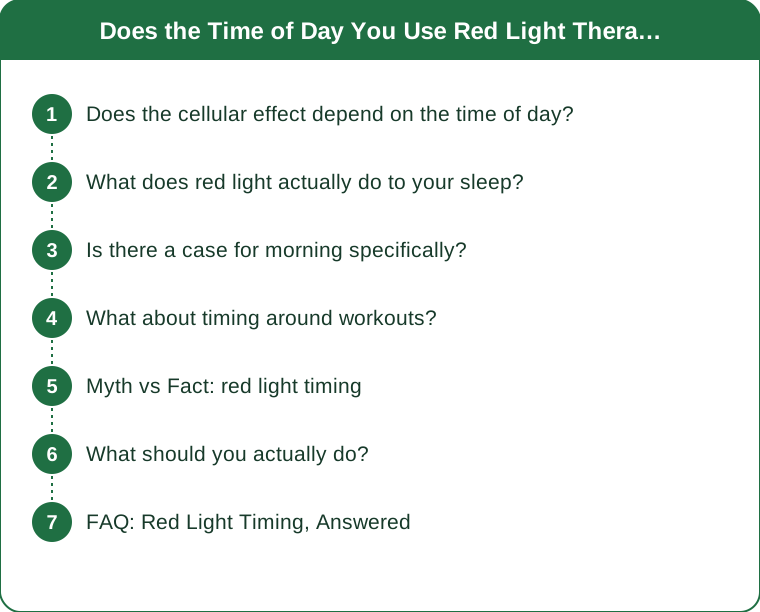
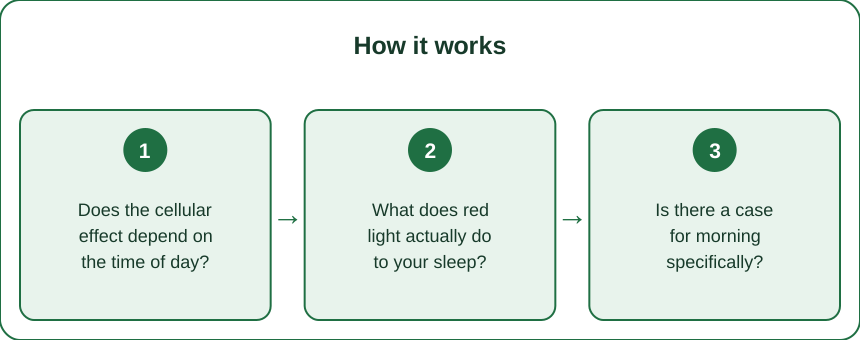
Does the cellular effect depend on the time of day?
Mostly not, as far as current evidence suggests. The proposed mechanism of photobiomodulation involves light in specific wavelengths being absorbed by mitochondria and influencing cellular energy processes. That machinery is running all day.
What this means practically: if your goal is skin, joint comfort, or recovery, the session you actually do beats the theoretically optimal one you skip. Timing is a rounding error compared to consistency, and consistency is where nearly everyone’s routine fails.
Where timing genuinely enters the picture is in the things surrounding the session rather than the mechanism itself:
- Your sleep, because a panel is a light source and you are using it near bedtime.
- Your training, because the timing relative to a workout may matter for recovery goals.
- Your adherence, because a time you can reliably hit beats one you cannot.
That third one is the largest effect in this article and the least interesting, which is why it is usually left out.
What does red light actually do to your sleep?
Less harm than blue light, and more than nothing.
Melatonin suppression is strongly wavelength-dependent. The receptors involved are most sensitive to blue light around 480nm and far less sensitive to red wavelengths around 660nm and near-infrared around 850nm. This is the basis for the common claim that red light does not affect sleep.
The claim is directionally right and often overstated. Two caveats:
Intensity matters, not just wavelength. A therapy panel is genuinely bright — far brighter than a red night light. Sufficient intensity at any wavelength produces some effect, and panels are designed to deliver a lot of photons.
Individual sensitivity varies considerably. Some people are noticeably more light-sensitive than others, and self-reported sleep effects from evening panel use are common enough to take seriously even where the mechanism is modest.
The practical read: if you use a panel an hour before bed and sleep fine, there is no reason to change. If you have trouble falling asleep and you run a bright panel at 10pm, that is worth testing by moving the session earlier for two weeks.
Is there a case for morning specifically?
There is a reasonable one, though it is more about alignment than about a direct benefit.
Morning light exposure of any kind supports circadian alignment. Bright light early in the day helps anchor your body clock, which improves sleep timing at night. Red light is not the ideal wavelength for this — daylight and blue-rich light do it far better — but a morning panel session at least sits in the right part of the day rather than fighting it.
There is also a practical argument. Morning routines are more protected than evening ones. Evening plans get displaced by work, social commitments, and tiredness. If adherence is the actual limiting factor — and for most people it is — morning wins on reliability alone.
The counterargument is real too: many people find an evening session easier because they are already home, already unhurried, and already in a routine. A session at 7pm that happens five days a week beats a 6am session that happens twice.
So the honest answer is that morning has a small theoretical edge and adherence has a large practical one. Pick the slot you will actually keep, and only move it if you have a specific reason.

What about timing around workouts?
This is where timing has the clearest case for mattering, and the evidence is genuinely mixed.
The general pattern in the research literature is that light exposure before exercise may support performance and reduce subsequent soreness, while exposure after exercise is aimed at recovery. Some studies have raised the question of whether post-exercise photobiomodulation could blunt certain training adaptations in the same way that some antioxidant supplementation appears to, though this is far from settled and the effect sizes involved are small.
A reasonable practical approach given the uncertainty:
- If your primary goal is recovery and feeling good, use it after training, which is what most people do and what most consumer guidance suggests.
- If your primary goal is maximizing training adaptation, and you are training seriously, putting the session before training or on rest days sidesteps the open question entirely.
- If your goal is skin, this whole consideration is irrelevant. Use it whenever.
None of this is settled science and anyone telling you it is has overstated the literature. The size of any timing effect is small relative to whether you use it consistently at all.
Myth vs Fact: red light timing
Myth: Red light before bed improves sleep.
Fact: The evidence for red light directly improving sleep quality is thin and mostly comes from small studies. What is better established is that red wavelengths suppress melatonin less than blue — which is an argument that it is less harmful, not that it is beneficial.
Myth: Morning sessions work better because your mitochondria are fresher.
Fact: This is a marketing narrative rather than a finding. There is no good evidence for a meaningful diurnal difference in photobiomodulation response.
Myth: You should not use it within two hours of bed.
Fact: This is a sensible precaution for light-sensitive individuals and not an established rule. Many people use panels in the evening without any sleep effect.
Myth: Splitting into two shorter sessions a day gets you more.
Fact: Dose response in photobiomodulation is biphasic — more is not linearly better, and there appears to be an optimal range beyond which additional exposure adds nothing. Two sessions is more likely to be redundant than additive.
Myth: Timing matters more than distance.
Fact: Distance from the panel changes your delivered dose enormously, because irradiance falls off sharply with distance. Timing changes it very little. If you are going to be precise about one variable, be precise about distance.
What should you actually do?
A short decision path.
Pick the slot you can hit five days a week. This decision dominates everything else in this article. A perfectly timed session done twice a month is worth less than a mediocre one done consistently.
Default to morning or early evening if you have no constraint pushing you elsewhere. It is the lowest-risk choice for sleep and it aligns with, rather than against, your body clock.
If you use it at night and sleep well, keep doing it. There is no reason to fix something that is not broken based on a modest theoretical concern.
If you have trouble falling asleep, test it. Move the session to morning for two weeks and see whether anything changes. That is a cleaner answer than any general guidance, because individual light sensitivity varies enormously.
Get the distance right before you optimize the hour. Most people’s routines are far more compromised by standing too far from the panel than by using it at the wrong time of day.
As the days shorten through autumn, one genuine adjustment is worth making: if you were doing evening sessions in summer daylight and are now doing them in the dark, the same panel represents a much larger share of your total evening light exposure. That is the scenario where a sleep effect is most likely to appear, and it appears seasonally rather than because anything about your routine changed.
FAQ: Red Light Timing, Answered
Can I use it right after waking up?
Yes. Just do not use it as a substitute for actual morning daylight, which does far more for circadian alignment than a red panel can.
Does it matter if I use it before or after skincare products?
Yes, and this matters more than time of day. Anything opaque on your skin blocks light. Clean, bare skin means the light reaches you. Apply products afterward.
Is every day better than every other day?
Up to a point. Most consumer guidance suggests three to five sessions a week, and there is little evidence that daily is meaningfully better than five. Consistency across weeks matters more than frequency within a week.
Should I change the timing in winter?
Not necessarily, but if evening sessions are now happening in full darkness where they used to happen in daylight, watch your sleep. That is a real change even though nothing about your routine moved.
TL;DR:
- The cellular mechanism appears largely time-independent, so for skin and recovery goals, consistency matters far more than the hour.
- Red wavelengths suppress melatonin much less than blue, but therapy panels are bright and individual sensitivity varies — late-night use is not automatically harmless.
- Morning has a small alignment advantage; evening often has a large adherence advantage. Pick the slot you will actually keep.
- Timing around workouts is the one place with a real open question, and putting sessions before training or on rest days sidesteps it.
- Distance from the panel affects your dose far more than time of day does — fix that first.
If you are going to change one thing after reading this, make it distance rather than timing. And if you have been doing evening sessions through summer daylight and are now doing them in the dark, keep an eye on your sleep — that shift happens every autumn without anyone deciding to make it.
Keep Reading
This article is for general informational purposes only and is not medical advice. Always consult a qualified health professional for guidance specific to you.