Why When You Use Red Light Therapy Relative to Your Workout Changes What It Actually Does
Quick Answer: Pre-workout red light therapy is more associated with modest performance and muscle-priming effects, while post-workout use is more associated with recovery and reduced soreness support, so the right timing genuinely depends on which of those two goals you’re targeting.
Red light therapy gets discussed as a single, general wellness tool, but its practical effect shifts noticeably depending on where you place it around your training session.

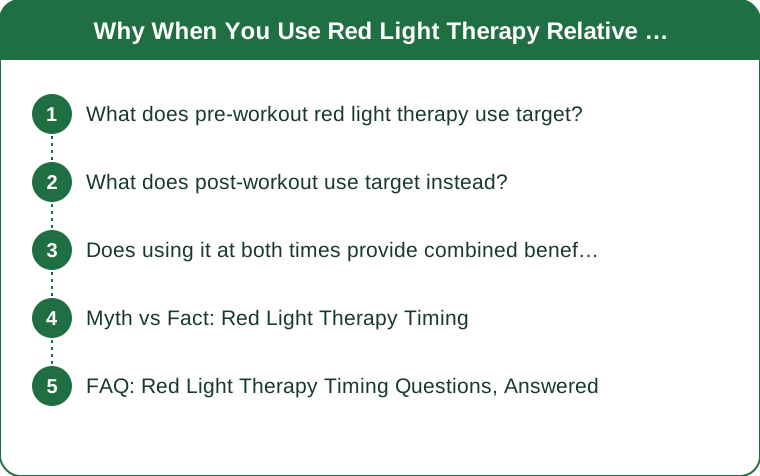
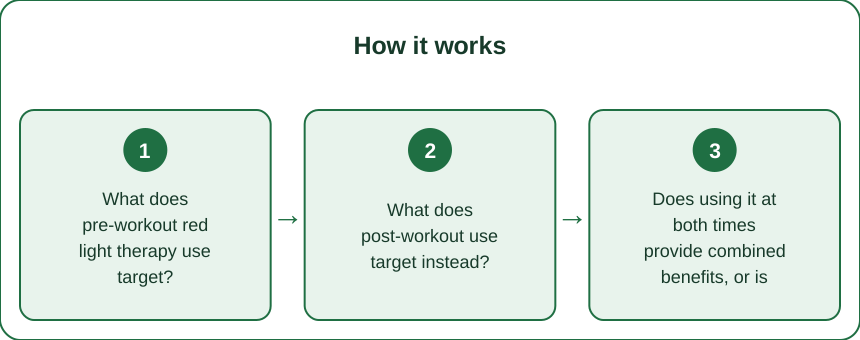
What does pre-workout red light therapy use target?
Some research suggests that red light exposure before exercise may support mitochondrial function in the targeted muscle, which is associated with modest improvements in fatigue resistance during the session that follows. This use case is about priming the muscle, not treating something that’s already happened.
What does post-workout use target instead?
Post-workout use is more commonly associated with supporting the recovery process — some studies point to reduced perceived muscle soreness and inflammation markers when red light is applied to worked muscle groups shortly after training, compared to no treatment. This use case is about supporting the repair phase, a fundamentally different goal from pre-workout priming.

Does using it at both times provide combined benefits, or is that overkill?
There isn’t strong evidence that doing both provides a meaningfully larger combined effect compared to choosing the timing that matches your specific goal, and for most home users, picking one consistent timing based on your primary goal (performance vs recovery) is more practical than trying to fit in two sessions around every workout.
Myth vs Fact: Red Light Therapy Timing
Myth: Red light therapy works the same regardless of when you use it. Fact: Available evidence suggests distinct effects depending on whether it’s used before or after exercise.
Myth: You need a red light session both before and after every workout for it to be worth doing. Fact: A single, goal-matched session is a reasonable and more sustainable approach for most people.
Myth: Red light therapy timing matters as much as consistency does. Fact: Consistent use over weeks matters more for cumulative benefit than getting the exact timing perfect on any single day.
FAQ: Red Light Therapy Timing Questions, Answered
If I’m mainly trying to reduce next-day soreness, when should I use it?
Post-workout, ideally within a couple hours of finishing your session, aligns with the recovery-focused use case the evidence more strongly supports.
Is there a risk to using red light therapy right before intense exercise?
No significant risk is documented, though it’s reasonable to avoid it immediately before very high-intensity work if you’re new to the practice, simply to see how your body responds first.
How long before results from either timing approach become noticeable?
Most users report needing several weeks of consistent sessions, regardless of timing choice, before subjectively noticing a difference in performance or recovery.
TL;DR:
- Pre-workout red light use is more linked to muscle-priming and performance support
- Post-workout use is more linked to recovery support and reduced perceived soreness
- Doing both isn’t clearly better than picking the timing that matches your specific goal
- Consistency over weeks matters more than nailing the exact timing on any given day
Before your next session, decide whether you’re chasing a performance edge or better recovery — that answer should decide when you actually use the panel.
Keep Reading
This article is for general informational purposes only and is not medical advice. Always consult a qualified health professional for guidance specific to you.