Why Red Light Therapy Rarely Shows Visible Results After Just One or Two Sessions
You did your first red light session. You looked in the mirror afterward. Nothing.
Second session, same. By session four you’re wondering whether you’ve bought a very expensive lamp.
You probably haven’t — but you’ve almost certainly been sold a timeline that doesn’t match the biology.
Quick Answer: Red light therapy works by stimulating mitochondrial activity in cells, and that effect accumulates across many sessions rather than producing a visible change from any single dose. No visible result after one or two sessions is the expected outcome, not a failure. Use it consistently 3–5 times per week for at least 8–12 weeks before judging whether it’s doing anything for you.

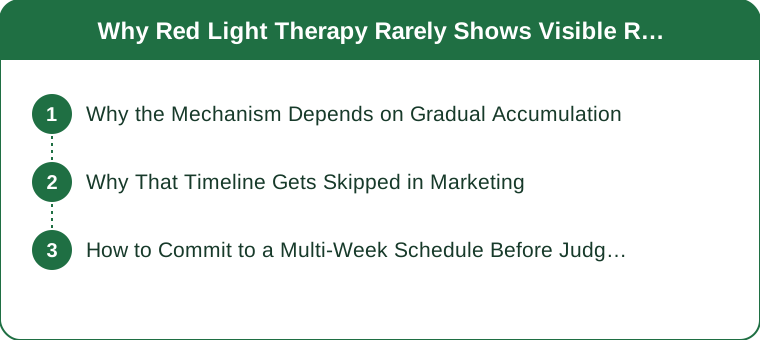
Why Doesn’t Red Light Therapy Show Results Immediately?
Because the mechanism is cumulative by design.
The working explanation is that specific red and near-infrared wavelengths are absorbed by mitochondria — the structures inside your cells that produce energy — and modestly increase their activity. The proposed downstream effects (more cellular energy available for repair processes, changes in inflammatory signaling) are gradual, small per session, and only add up across repeated exposure.
Two consequences follow, and they explain almost everything about the timeline:
A single session’s effect is below the visibility threshold. It’s not that nothing happened. It’s that what happened is a small nudge to cellular activity, and skin doesn’t visibly reorganize itself off a single nudge. This is the same reason one workout doesn’t change your body composition — the mechanism is real and the per-session dose is simply small.
Skin turns over on its own schedule regardless. Even a treatment that works perfectly is limited by how fast skin actually renews and remodels, which runs on a scale of weeks to months, not days. Anything acting on skin structure is bounded by that clock no matter how good it is.
So “no visible change after two sessions” carries essentially zero information about whether it will work for you. It’s the expected result either way, which makes it a useless data point — and an expensive one to act on.

Why Does the Marketing Make It Look Faster Than It Is?
Because of how the images are arranged.
The standard piece of red light marketing shows a glowing session photo next to a finished “after” result. Nothing in that layout is literally a claim about speed. But visual adjacency reads as causation — the implied story is this session produced that result, when the actual story is that result came from roughly three months of consistent sessions.
The gap between those two stories is where most people quit.
Three things worth watching for when you’re evaluating any device or clinic:
- Missing timelines. If a before/after doesn’t state how many weeks and how many sessions per week it represents, the number is being omitted for a reason.
- Session-photo adjacency. A single glowing-face image next to a result photo is doing implication work.
- Vague benefit language. Broad promises without a stated protocol — wavelength, distance, session length, frequency — mean there’s no protocol you can actually follow or evaluate.
The honest framing is that red light therapy is a slow, modest, cumulative intervention. It’s just harder to photograph.
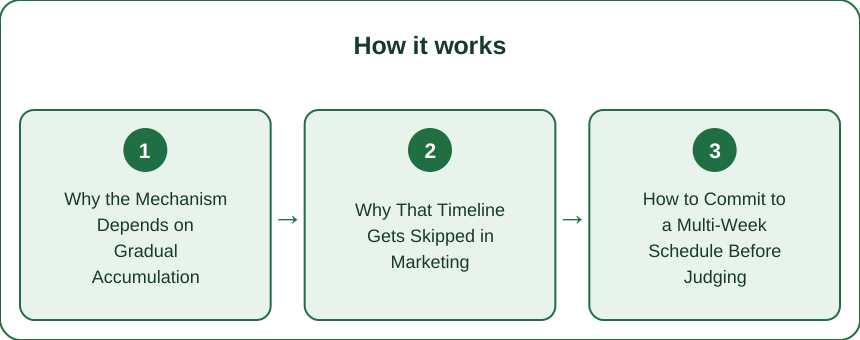
How Long Should You Actually Commit Before Judging It?
3–5 sessions per week for at least 8–12 weeks, then evaluate.
That number isn’t arbitrary — it’s chosen to match the accumulation speed of the mechanism. Judging at week two is measuring before the process has had a chance to produce anything measurable.
To make that 8–12 weeks actually informative:
Take a proper baseline photo on day one. Same spot, same lighting, same time of day, no makeup, neutral expression. This is the single most useful thing you can do, because gradual change is exactly the kind your memory is worst at tracking. Without a baseline you’ll be comparing week 12 to a vague impression of how you looked in July, and that comparison is worthless in both directions — it can invent improvement that isn’t there or hide improvement that is.
Photograph every two weeks, same conditions.
Keep everything else stable. Don’t start a new retinoid, a new device, and a new supplement in the same month. If you change three things and something improves, you’ve learned nothing about which one did it.
Track sessions, not intentions. A calendar mark per session. “About three times a week” often turns out to be 1.5 when actually counted, and an under-dosed protocol failing tells you nothing about a properly-dosed one.
Set the evaluation date now, on the calendar, at 12 weeks. Deciding in advance when you’ll judge protects you from both quitting at week three and from drifting on indefinitely at week forty with nothing to show.
Myth vs Fact
Myth: If it were working, you’d feel or see something in the first week. Fact: The mechanism operates through gradual cellular accumulation and is bounded by skin’s natural turnover rate. Week-one absence of change is the expected outcome regardless of whether the treatment will eventually work for you.
Myth: Longer sessions produce faster results. Fact: Devices specify session lengths because dose depends on wavelength, output, and distance — more is not straightforwardly better, and there’s reason to think benefits plateau. Follow the manufacturer’s protocol rather than improvising longer sessions.
Myth: Before-and-after photos in marketing show what one session does. Fact: They almost always represent a multi-month course of consistent treatment, with the number of sessions frequently omitted. The visual adjacency implies a speed the biology doesn’t support.
Myth: Red light therapy is a substitute for medical treatment. Fact: It’s studied for several applications with varying levels of evidence, and results differ by condition, device quality, and individual. It isn’t a replacement for evaluation of a specific skin or medical concern. If you have a diagnosed condition, are on photosensitizing medication, or have an eye condition, talk to a dermatologist or physician before starting — and use the eye protection your device specifies.
Myth: You can judge it against a friend’s experience. Fact: Device output, wavelength, distance, session frequency, and individual response all vary substantially. Someone else’s twelve weeks isn’t a forecast of yours.
FAQ
How many red light therapy sessions before you see results?
Most protocols call for 3–5 sessions per week, with a realistic evaluation window of 8–12 weeks. Some people notice changes earlier and some later, and the honest answer is that individual response varies quite a lot. Judging before eight weeks is measuring too early for the mechanism involved.
Is it normal to see no change after a month of red light therapy?
Yes — a month is roughly four to five weeks of a protocol whose evaluation window is eight to twelve. If you’re at week four with no visible change and you’ve been consistent, keeping to the schedule and reassessing at week twelve with baseline photos is the reasonable move. If you reach twelve weeks of genuine consistency with nothing, that’s a meaningful result.
Does using red light therapy more often speed up results?
Not reliably, and it may not help at all. Dose response for light therapy isn’t linear, and manufacturers set session length and frequency for a reason. Consistency at the recommended frequency matters far more than intensity — a properly-followed three-times-a-week protocol beats an erratic daily one.
TL;DR:
- Red light therapy works by cumulative stimulation of mitochondrial activity — a single session’s effect is below the visible threshold by design.
- Skin turnover runs on weeks to months, which caps how fast any skin treatment can show results.
- Marketing implies speed by placing one session photo next to a multi-month result, usually with the session count omitted.
- Commit to 3–5 sessions/week for 8–12 weeks before judging.
- Take a dated baseline photo in fixed lighting and re-shoot every two weeks. Memory is unreliable for gradual change.
- Change one thing at a time and track actual sessions, not intentions.
- Diagnosed skin conditions, photosensitizing medication, or eye concerns → talk to a doctor first, and use the specified eye protection.
Keep Reading
This article is for general informational purposes only and is not medical advice. Always consult a qualified health professional for guidance specific to you.