Why Red Light Therapy Feels Warm on Your Skin When It's Not Supposed to Work Through Heat
Quick Answer: The warmth you feel during red light therapy comes mostly from the device’s LED heat output and the light energy being partially absorbed as heat at the skin surface — it’s a real but secondary effect, separate from the deeper cellular mechanism (photobiomodulation) that red and near-infrared wavelengths are actually intended to trigger.
You were told red light therapy works differently than a heating pad or sauna, but your skin genuinely feels warm during a session, and it’s fair to wonder whether that warmth is actually the thing doing the work.
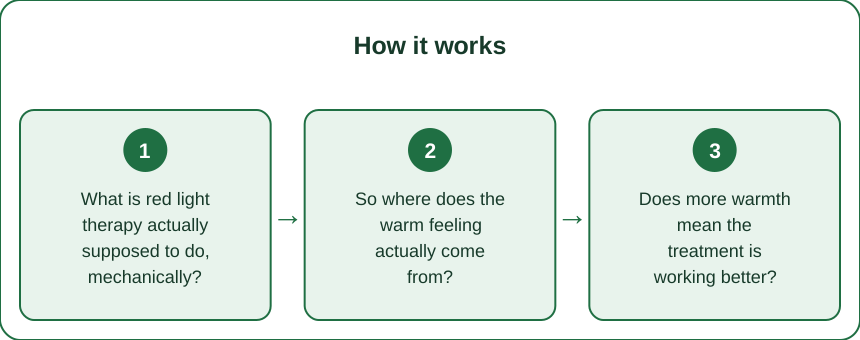
What is red light therapy actually supposed to do, mechanically?
The intended mechanism is photobiomodulation — specific red and near-infrared wavelengths are absorbed by mitochondria in skin cells, where they’re believed to support cellular energy production (ATP synthesis) and reduce localized inflammation. This is a light-wavelength-driven cellular process, distinct from simply warming tissue the way a heating pad does.
So where does the warm feeling actually come from?
Two sources, both real but separate from the therapeutic mechanism: first, LED panels generate some heat as a byproduct of running, especially with many bulbs close together; second, light energy hitting skin is partially absorbed and converted to heat at the surface, similar to standing in sunlight. Neither of these is the photobiomodulation effect itself — they’re a real but incidental physical sensation.
Does more warmth mean the treatment is working better?
No — warmth intensity isn’t a reliable indicator of treatment effectiveness, since it’s driven mainly by device heat output and distance from the panel, not by how much cellular-level light absorption is happening. A cooler, well-designed panel at the correct distance can be therapeutically effective while feeling only mildly warm.

Myth vs Fact: Red Light Warmth Edition
Myth: If a session doesn’t feel warm, it’s not working. Fact: therapeutic effect depends on wavelength, dose, and distance — not skin-surface temperature — so a session can be effective while feeling barely warm.
Myth: More heat means deeper penetration. Fact: near-infrared wavelength specifically (not heat) is what’s associated with deeper tissue penetration in current research — device heat and wavelength penetration are separate variables.
Is significant heat during a session ever a problem?
If a panel gets uncomfortably hot rather than mildly warm, that’s more likely a sign of a lower-quality or poorly ventilated device running its LEDs inefficiently, not a sign of stronger treatment — and prolonged excessive heat at close range risks skin discomfort or minor burns unrelated to the intended light therapy benefit.
FAQ: Red Light Therapy Warmth Questions, Answered
Should I feel nothing at all during an effective session?
A mild, comfortable warmth is common and not a problem — the concern is only when warmth becomes the dominant sensation or feels uncomfortably hot.
Does a cooling fan on the device reduce effectiveness?
No — a fan just manages device heat output and doesn’t interfere with the wavelength output responsible for the therapeutic mechanism.
This is general information, not medical advice — evidence for red light therapy’s benefits and appropriate use is still developing, so consult a professional for specific skin or health concerns.
TL;DR:
- The intended mechanism is light-wavelength cellular absorption, not heat
- Session warmth mostly comes from LED device heat and surface light absorption
- More warmth doesn’t indicate a more effective session
- Uncomfortable heat suggests a device issue, not a stronger treatment
Keep Reading
This article is for general informational purposes only and is not medical advice. Always consult a qualified health professional for guidance specific to you.