Why Red Light Sessions Stop Feeling Like They Do Anything
Quick Answer: Red light sessions stop feeling noticeable partly because the effects were never primarily sensory — the warmth you felt initially was novelty and infrared heat, not the mechanism. Real photobiomodulation effects are cumulative and modest, appearing over weeks in skin quality or perceived soreness rather than as an in-session sensation. If results genuinely plateaued, the usual causes are distance drift, declining LED output, or a dose that was too high all along — more is not better with light.
Weeks one to four, you noticed something. It felt like it was working.
Month three, sessions feel like sitting in front of a lamp.
Some of that is real and some of it was never the point.
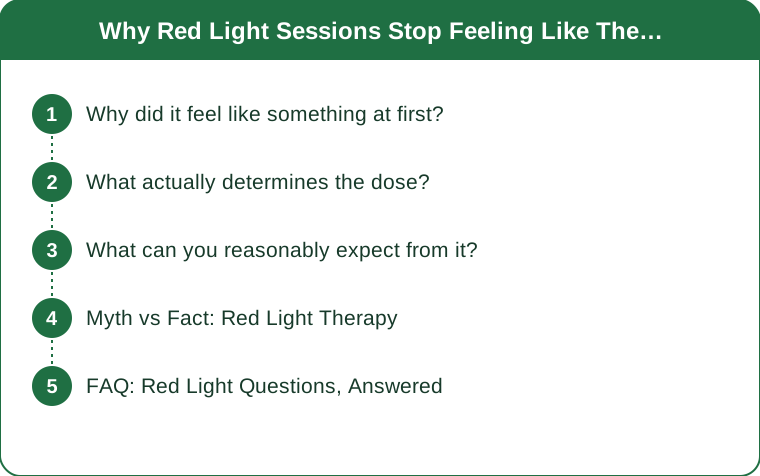
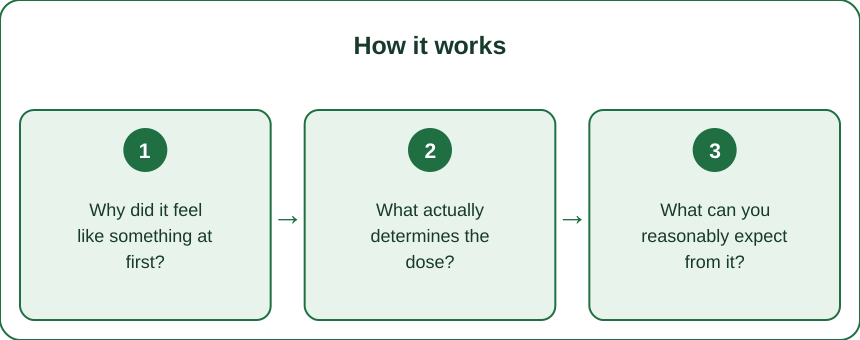
Why did it feel like something at first?
Several things that are not the mechanism, plus one that is.
Infrared wavelengths produce warmth you can feel. Near-infrared around 810 to 850nm generates a gentle heating sensation. Red light around 660nm does not, meaningfully.
Novelty amplifies perception. Any new routine feels more noticeable in the first weeks, and this is well documented across every intervention.
The relaxation is real but non-specific. Ten minutes sitting still with your eyes closed produces a genuine parasympathetic response regardless of the light.
Expectation effects are substantial for anything where the outcome is subjective, and soreness and skin appearance are both subjective.
The actual mechanism is silent. Photobiomodulation is proposed to act on mitochondrial cytochrome c oxidase, and that process produces no sensation whatsoever.
So feeling less over time is expected, and it says nothing about whether the underlying effect is present.
What actually determines the dose?
Two variables that most home users never measure, and one that changes without notice.
Distance is the dominant variable. Irradiance falls off sharply with distance — roughly with the square of it. Moving from 15cm to 30cm can cut the delivered dose to a quarter.
Time multiplies irradiance into dose. Dose is measured in joules per square centimetre, and it is irradiance multiplied by seconds. Halving distance and keeping time constant quadruples the dose.
There is a biphasic dose response. This is the crucial and widely ignored point: too much light produces less benefit than the right amount. More is genuinely not better, and this is one of the few areas where that is well established.
Typical targets sit around 3 to 10 J/cm² for skin and higher for deeper tissue, though the research is far from settled.
LED output declines over time. Panels lose output gradually, so an identical routine delivers less after two years than it did new.
And most people drift further away over time. The chair moves, the panel gets repositioned. Marking the floor with tape fixes it permanently.

What can you reasonably expect from it?
Honest expectations, separated by how good the evidence is.
Best supported: skin appearance. Improvements in fine lines, texture and collagen density appear in several trials, typically over 8 to 12 weeks of consistent use.
Reasonably supported: reduced muscle soreness. Modest effects on delayed-onset soreness and perceived recovery, though study quality varies considerably.
Mixed: joint pain and inflammation. Some positive findings, inconsistent methodology, and highly variable dosing across studies.
Weak: hair growth, fat loss, performance enhancement. Marketing outruns the evidence substantially here.
Timeline: expect nothing before 4 weeks and judge at 12. Anything appearing in week one is likely novelty rather than mechanism.
Consistency beats intensity. Three to five sessions weekly at a moderate dose outperforms occasional long sessions, given the biphasic response.
This is general information, not medical advice. Anyone with a photosensitive condition, taking photosensitising medication, or with eye concerns should speak to a doctor before use.
Myth vs Fact: Red Light Therapy
Myth: more time equals more benefit. Fact: the biphasic dose response means excessive exposure reduces the effect. This is the most common and most consequential mistake.
Myth: you should feel warmth for it to work. Fact: warmth comes from near-infrared and ambient heat. The proposed mechanism is not thermal.
Myth: any red LED works. Fact: wavelength matters — roughly 630 to 660nm and 810 to 850nm are the studied ranges. A red bulb from a hardware shop is not the same thing.
Myth: panels do not wear out. Fact: LED output declines over years, and a panel delivering less irradiance changes your effective dose without any visible sign.
Myth: you need eye protection always. Fact: red and near-infrared at these intensities are generally considered low risk, but direct staring is unwise and eye protection is sensible for facial panels.
Myth: it replaces recovery basics. Fact: sleep, protein and training load management dwarf it. It is a marginal addition on top of those, not a substitute for any of them.
FAQ: Red Light Questions, Answered
How far should I sit from the panel?
Follow the manufacturer’s stated distance for their irradiance figures, commonly 15 to 30cm. Then mark it, because drift is the most common dosing error.
How long should a session be?
Usually 10 to 20 minutes per area at typical home-panel irradiance. Longer is not better.
How often?
Three to five times weekly is the common protocol. Daily is acceptable at a moderate dose.
When will I see skin changes?
Studies generally show effects at 8 to 12 weeks of consistent use. Nothing meaningful should be expected in the first month.
Does it work through clothing?
No. Light needs direct skin exposure to reach tissue.
Do panels wear out?
Yes, gradually. Output declines over years of use, which reduces the delivered dose without any visible change to the panel.
TL;DR:
- The sensation was mostly novelty and infrared warmth — the proposed mechanism produces no feeling at all.
- Distance is the dominant dose variable; small changes alter the delivered dose dramatically.
- The response is biphasic: too much light gives less benefit than the right amount.
- Best-supported use is skin appearance over 8 to 12 weeks; soreness effects are modest.
- Mark your distance on the floor and remember panels lose output over years.
Tape a mark where your chair should sit. It is the cheapest way to make sure the dose you think you are getting is the dose you are actually getting.
Keep Reading
This article is for general informational purposes only and is not medical advice. Always consult a qualified health professional for guidance specific to you.