Why Distance From the Panel Matters More Than Session Length
Quick Answer: Delivered dose is intensity multiplied by time, and intensity from a panel drops off steeply with distance. Because of that falloff, moving from 6 inches to 12 inches can reduce intensity by considerably more than doubling your session length compensates for — which makes distance the variable worth getting right first.
Everyone asks how many minutes. Almost nobody asks how many inches, and the inches are doing more of the work.

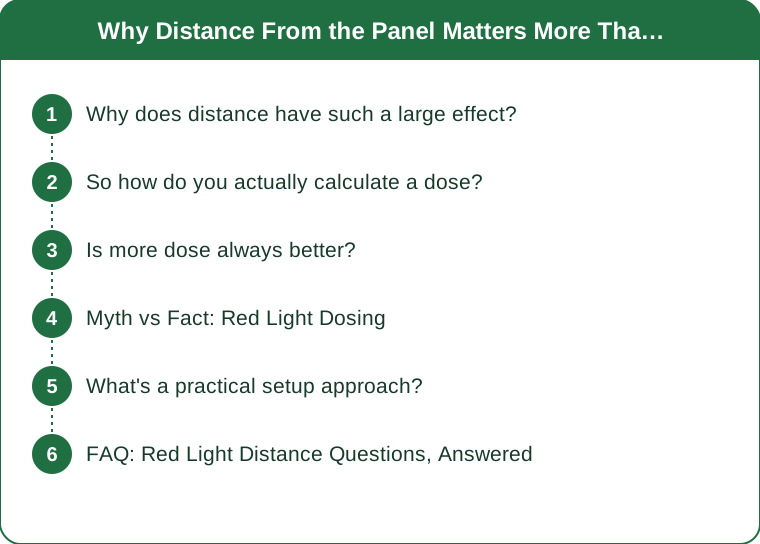
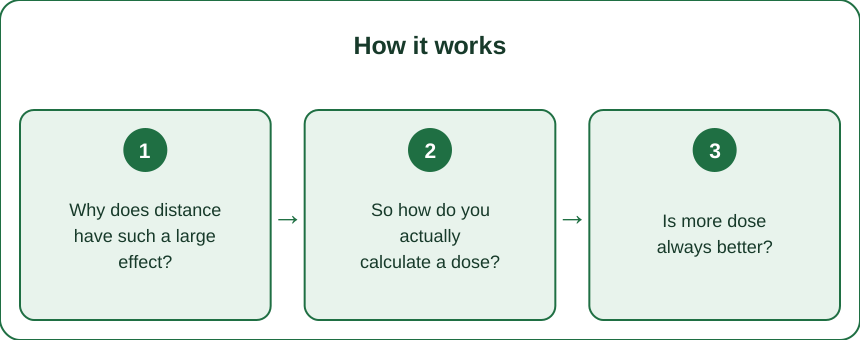
Why does distance have such a large effect?
Light spreading out from a source loses intensity with distance in a way that’s much steeper than intuition suggests — roughly following an inverse-square relationship for a point source, and somewhat gentler for a large flat panel but still substantial.
The practical implication is that manufacturer irradiance figures are meaningless without the distance they were measured at. A panel advertising a high irradiance at 3 inches and one advertising a lower figure at 12 inches may be describing similar devices. This is the single most common source of confusion when comparing products.
So how do you actually calculate a dose?
Dose is typically expressed in joules per square centimeter, and it equals irradiance (mW/cm²) multiplied by time in seconds, divided by 1000.
So a panel delivering 100 mW/cm² for 300 seconds gives 30 J/cm². The key point is that halving your intensity requires doubling your time to reach the same dose — and if distance cut your intensity by considerably more than half, the time adjustment needed is larger than most people make. Use the manufacturer’s irradiance figure at the distance you actually sit, not their headline number.
Is more dose always better?
No, and this is where red light therapy differs from most interventions. The literature describes a biphasic dose response — benefit increasing up to an optimal dose, then declining with further exposure.
That means longer sessions past the optimal point may reduce the effect rather than adding to it. The practical consequence: dialing in a reasonable distance and a moderate time, then holding it consistently, is a better strategy than escalating session length when results seem slow.
Myth vs Fact: Red Light Dosing
Myth: Closer is always better. Fact: Very close positioning raises intensity but reduces the treated area and can create heat. Manufacturer-recommended distances exist for reasons beyond marketing.
Myth: Higher irradiance panels are automatically better. Fact: They deliver a given dose faster, which is a convenience benefit. Given the biphasic response, more intensity isn’t inherently more effective.
Myth: Session length is the main variable to adjust. Fact: Distance changes intensity more dramatically than realistic session-length adjustments change total dose.
Myth: All red light devices are comparable if the wavelength matches. Fact: Wavelength, irradiance at a stated distance, beam angle, and treated area all vary enormously. Wavelength alone tells you very little.
What’s a practical setup approach?
Fix the distance first, then set the time, then stop changing things.
Mark the distance physically — tape on the floor, a fixed chair position — because eyeballing it varies by several inches session to session, which is enough to meaningfully change the dose. Use the manufacturer’s stated irradiance at that specific distance to calculate a time that lands in their recommended dose range.
Then hold both constant for at least several weeks. Changing two variables at once makes it impossible to know what’s working, and given the biphasic response, escalating when results feel slow is as likely to hurt as help.
FAQ: Red Light Distance Questions, Answered
What distance do most manufacturers recommend?
It varies substantially by device power and panel size, which is exactly why the device’s own documentation matters more than any general figure.
Does clothing block the light?
Yes, substantially. Light needs to reach skin directly, and most fabric blocks the relevant wavelengths.
Is eye protection necessary?
Many manufacturers include or recommend eyewear, particularly with higher-powered panels. Follow the device’s guidance — this is general information, not medical advice, and red light therapy research is still developing across most claimed applications.
TL;DR:
- Intensity falls off steeply with distance, making inches more consequential than minutes
- Dose = irradiance × time, using irradiance at your actual distance
- The dose response is biphasic — more is not reliably better past an optimum
- Mark your distance physically so it doesn’t drift session to session
- Hold distance and time constant for weeks before changing anything
Get the distance right once and the time question mostly answers itself. Guess at the distance and no session length will fix it.
Keep Reading
This article is for general informational purposes only and is not medical advice. Always consult a qualified health professional for guidance specific to you.