Why Five Short Red Light Sessions Beat Two Long Ones
Quick Answer: Red light therapy appears to follow a biphasic dose response, meaning there is an optimal dose and both too little and too much produce weaker results. That makes session length a poor thing to increase, because doubling it can push you past the useful window. Frequency is the variable that scales safely, so five 10-minute sessions a week will generally outperform two 25-minute ones, even though the total exposure is similar.
When the week gets busy, people compress. With most things that works. With this, it works against you in a specific and well-documented way.
This blog has covered why results take weeks and why your distance from the panel sets the dose. This is the scheduling question, and it is the one people get wrong most often.
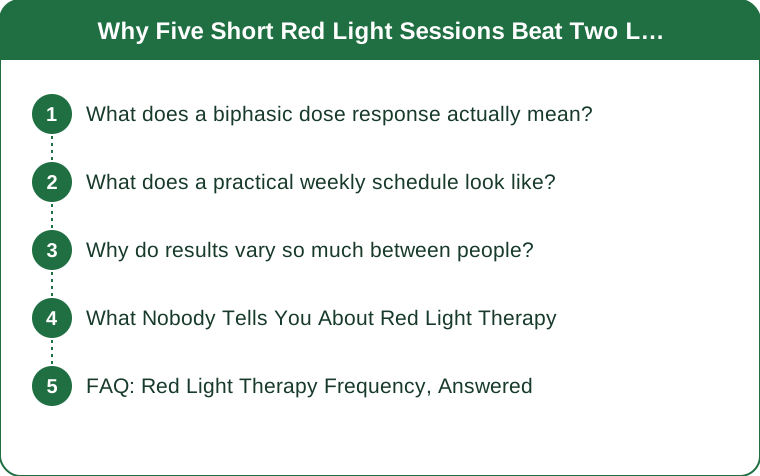
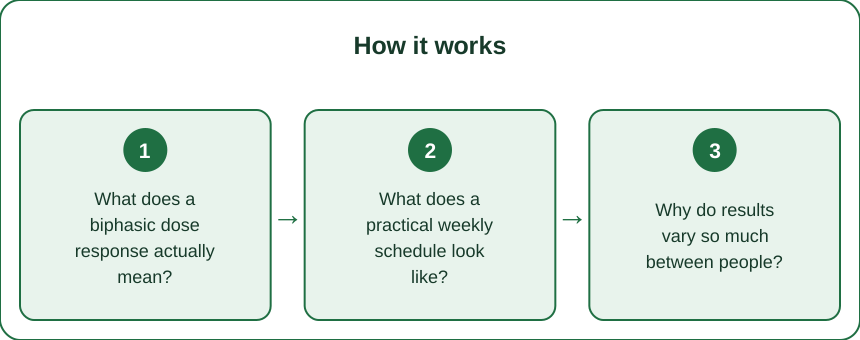
What does a biphasic dose response actually mean?
That more is not better past a certain point, and can be worse.
Most treatments people are familiar with are linear up to a limit. More exercise up to a point produces more fitness. This intuition is what people bring to light therapy, and it does not apply.
Biphasic means the response curve rises, peaks, and then falls. Below the optimal dose you get less effect. At the optimal dose you get the maximum. Above it, the effect declines again, and this has been observed consistently across the photobiomodulation literature.
Which makes session length a risky variable to increase. If a 10-minute session at your distance is near optimal, a 25-minute session is not two and a half times better, and it may be meaningfully worse.
Frequency does not have the same problem within reason. Repeated exposures at a good dose, spaced across days, appear to accumulate benefit in a way that a single long exposure does not replicate.
Distance is the other half of the dose calculation. Dose is intensity multiplied by time, and intensity falls sharply as you move away from the panel. Sitting twice as far away dramatically reduces what you receive, so distance and duration have to be considered together.
And this is why manufacturer guidance varies so much. Two panels with different power outputs need very different session lengths at the same distance. Following a time recommendation from a different device is a common way to end up well off the useful window.
What does a practical weekly schedule look like?
Short, frequent, and at a consistent distance.
Aim for four to five sessions a week rather than two. Consistency across days appears to matter more than any single session, and the habit is easier to maintain at short durations anyway.
Keep sessions at the length your device’s guidance specifies for your distance, typically in the range of 5 to 15 minutes for most consumer panels at close range. Resist the urge to extend them.
Fix your distance and mark it. A piece of tape on the floor removes the single largest source of inconsistency. Guessing the distance each session means an unknown dose each session.
Treat the same body area consistently. Rotating across different areas each session means each area receives a fraction of the frequency, which is exactly the variable you were trying to protect.
Pick a fixed time of day. Timing relative to workouts is a separate question this blog has covered, and the more important practical point is that a fixed slot is the difference between four sessions a week and one.
And give it eight to twelve weeks before judging. The mechanisms involved operate on cellular timescales, and skin and tissue turnover takes weeks. Assessing after two weeks tells you nothing, which is the most common reason people abandon it.
Why do results vary so much between people?
Because the delivered dose varies far more than the stated protocol does.
Panel power output differs by a large factor between devices. Two panels both described as red light therapy can deliver very different intensities at the same distance, which means identical session lengths deliver very different doses.
Distance is often not measured. Small changes in distance produce large changes in intensity, because intensity falls off sharply with distance. Someone sitting 15cm away and someone at 45cm are running completely different protocols.
Skin tone affects absorption. More melanin absorbs more light in the upper layers, which changes how much reaches deeper tissue. This is a real variable and it is rarely mentioned in protocols.
The target matters. Skin surface effects need far less penetration than joint or deep tissue effects, so the same session can be well dosed for one goal and poorly dosed for another.
Consistency differs enormously between people who describe themselves as regular users. Four times a week for three months is a different intervention from twice a week for six weeks, and both get reported the same way.
And expectations differ. The evidence base is stronger for some applications than others, and it is genuinely mixed in places. Anyone claiming uniform dramatic results across all uses is overstating what is known.
One safety note: eye protection matters with high-output panels, and anyone photosensitive, pregnant, or taking photosensitising medication should check with a doctor first. This is general information, not medical advice.
What Nobody Tells You About Red Light Therapy
Longer sessions are the most common self-inflicted mistake. The reasoning is sound for almost everything else in health and wrong here, and it is why so many enthusiastic users get worse results than casual ones.
Distance is measured from the panel surface, not from where it feels warm. Warmth is mostly from the panel’s own heat output and is not a guide to light intensity.
Skin needs to be bare and clean. Clothing blocks the light almost entirely, and heavy moisturisers or makeup can interfere with what reaches the skin. It sounds obvious and it is a common oversight.
The wavelength printed on the box is a nominal figure. Most panels emit across a range around the stated peaks, and quality varies in how tightly they hold to it. Cheap panels frequently deviate more than advertised.
Consistency over months is what separates people who see results from people who do not, far more than device choice or protocol details. This is unglamorous and it is the strongest observation in the whole area.
And the evidence is genuinely stronger for some uses than others. Skin and wound-related applications have the more established base; many other claimed uses are earlier-stage. Being honest about that is more useful than treating it as a cure-all.
FAQ: Red Light Therapy Frequency, Answered
Is it better to do longer sessions or more frequent ones?
More frequent. The dose response is biphasic, so extending a session can push past the optimal window, while adding sessions across the week scales safely.
How often should I use red light therapy?
Four to five short sessions a week is a reasonable target for most consumer panels, at a fixed distance and a consistent duration within your device’s guidance.
How long before I see results?
Eight to twelve weeks for most applications. Tissue turnover operates on that timescale, and assessing at two or three weeks gives you no useful information.
TL;DR:
- The dose response is biphasic, so more time per session is not better and can be worse.
- Scale frequency rather than duration: four to five short sessions a week beats two long ones.
- Mark your distance on the floor, because intensity falls off sharply and guessing means an unknown dose.
- Give it eight to twelve weeks, and follow your own device’s guidance rather than a protocol from a different panel.
If the week gets busy, cut the session length before you cut the number of sessions. That is the opposite of the usual advice and it is the right call here.
Keep Reading
This article is for general informational purposes only and is not medical advice. Always consult a qualified health professional for guidance specific to you.