What Is on Your Skin Decides What Your Red Light Panel Reaches
Quick Answer: Red and near-infrared wavelengths have to physically reach your skin to do anything, and what sits on the surface gets a vote: mineral sunscreens are the biggest blockers because zinc oxide and titanium dioxide are reflective pigments, makeup blocks and scatters in proportion to its pigment and shimmer content, and thick occlusive creams interfere modestly. Clear, light lotions matter little — and sweat matters almost none. The clean protocol costs nothing: session on bare, freshly cleansed, dry skin, with skincare and SPF applied after, not before.
For a therapy whose results run on consistency and dose, prep is the cheapest dose multiplier available.
Which products physically interfere with the light?
Rank them by what they contain, and the list sorts itself.
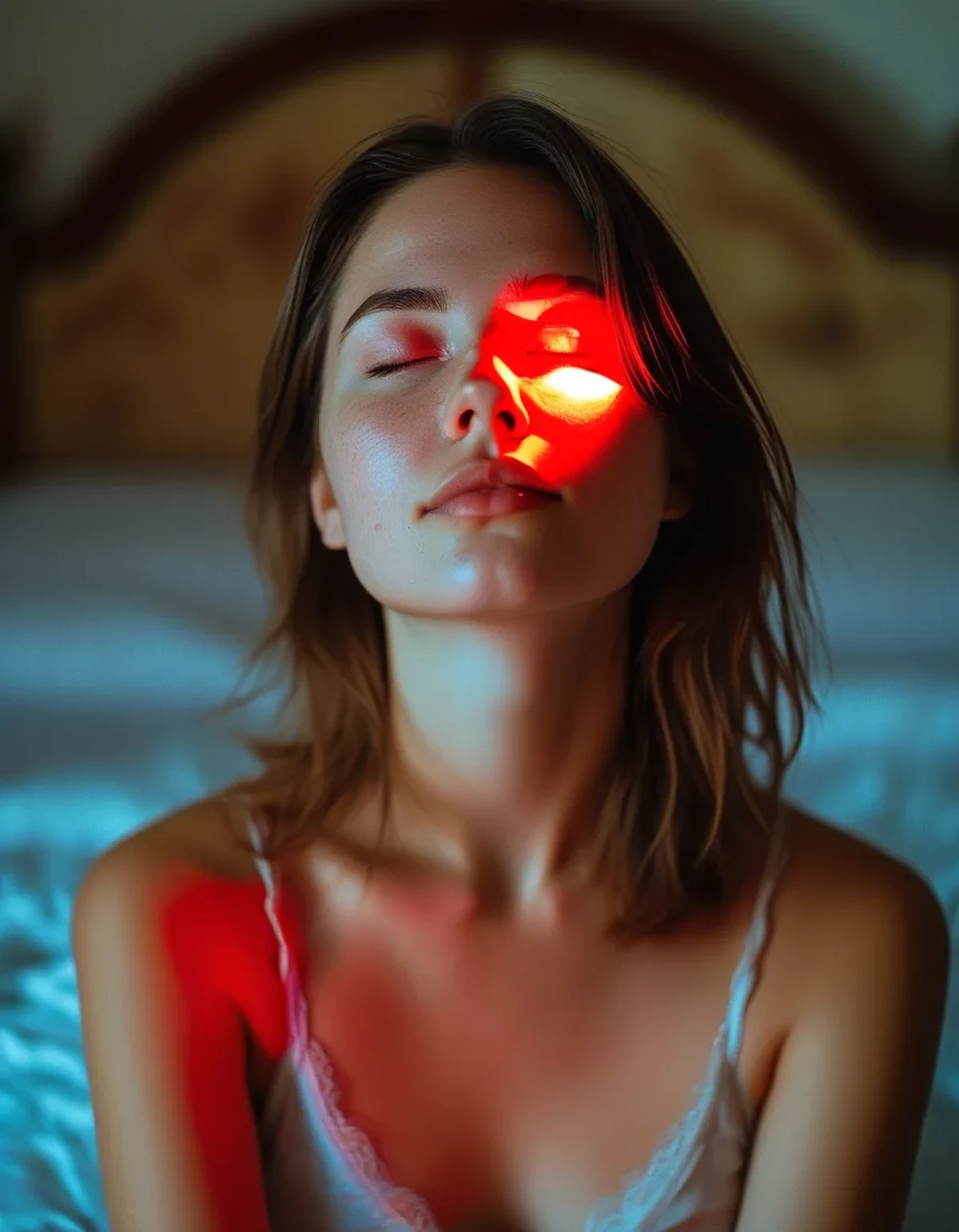
Reflectors sit at the top. Zinc oxide and titanium dioxide — the entire active mechanism of mineral sunscreen — are white pigments engineered to scatter and reflect light away from skin. They are broadest-spectrum against UV, but they do not politely stand aside for red wavelengths; a proper layer of mineral SPF turns your face into a partially mirrored surface for exactly the photons the panel is emitting. Doing a session over mineral sunscreen is paying full price for a discounted dose.
Pigments and shimmer come next. Foundation and concealer are suspensions of iron oxides and titanium dioxide — coverage is literally their job, and what covers skin from view covers it from light. Mica shimmer in highlighters and some tinted moisturizers adds glitter-scale mirrors. The heavier the coverage, the bigger the toll; a full-coverage matte face blocks meaningfully, a sheer tint much less.
Occlusives interfere modestly. Thick creams, petrolatum balms, and heavy oils form films that absorb and scatter a little across the spectrum — not walls, but haze.
Chemical-filter sunscreens are the nuance case: their filters are engineered to absorb ultraviolet specifically and are largely transparent to red — but the lotion vehicle they ride in is still a film, and modern formulas often blend in mineral filters anyway. Treat any SPF as a before-session no.
And the innocents: thin hydrating lotions, hyaluronic serums, sweat, and plain water barely register. The rule compresses to one line — if it hides or mattifies your skin, it is hiding it from the panel too.
Why does the order of operations matter so much?
Because the same products that block light going in are fine — often better placed — after the session.
The entire premise of the therapy is photons reaching chromophores in living tissue. Every layer between emitter and dermis is upstream of everything else you are doing: distance, timer, wavelength, and consistency all multiply against whatever fraction actually gets through the surface. Prep is the first term in that multiplication, and the only one that costs zero minutes once it becomes routine.
So the sequence writes itself. Cleanse or thoroughly wipe, dry, session, then the rest of your routine. Doing skincare after rather than before loses you nothing — serums and moisturizers do their work regardless of whether a light session preceded them — while doing it before quietly taxes the session. Morning users put SPF on after the panel, exactly where it belongs in the routine anyway. Evening users cleanse off the day — which matters more than people assume, because a day’s accumulation of SPF, foundation, sebum, and city grime is a composite film nobody would deliberately apply before a session, yet effectively is applied by skipping the cleanse.
Dry matters a little too: water droplets on skin scatter light unevenly, so towel-dried beats dripping.
One honest caveat about magnitude: nobody can hand you an exact percentage lost to a given foundation — it varies with formula, thickness, and wavelength. But the direction is not in doubt, and for a practice whose published successes lean on consistent, adequate dosing over weeks, systematically shaving the dose with surface films is the most preventable inefficiency in the whole routine.

What Nobody Tells You About Panel Sessions
Distance moves your dose more than any product does. Light intensity falls off steeply with distance from the panel — drifting from six inches to eighteen because you settled somewhere comfortable cuts delivered intensity far more than a layer of moisturizer ever would. Fix your distance to the device’s guidance, mark the spot, and keep it identical across sessions; an inconsistent distance makes every other variable unreadable.
Post-workout sessions are fine — after a wipe. Sweat itself is water and barely interferes, but letting it dry into a salty film is worth a thirty-second rinse or towel pass first. The gym-then-panel pipeline works; just arrive at the panel clean-ish and dry.
Eye protection and eye makeup have a quiet conflict. If you use the provided goggles or keep eyes closed per your device’s instructions, mascara and eye products end up pressed against straps and lids anyway — one more argument for the bare-face session, since eye-area products migrate under warmth.
Self-tanner is surface pigment, and it costs a little. The bronze layer sits in the outermost dead cells and absorbs some incoming light — not a dealbreaker, but a freshly applied dark tan is a real film. Time heavy tanning and panel priorities accordingly.
Clothing is a wall, not a filter. Any fabric between panel and skin reduces the dose to near-irrelevance for skin outcomes — sessions for a covered area are sessions for the fabric. Bare the target, whatever it is.
Consistency still beats perfection. A slightly imperfect daily session outperforms a laboratory-grade weekly one. Prep is a multiplier on showing up, never a reason not to.
What is the five-minute prep that maximizes a session?
A sequence simple enough to survive real life, morning or evening.
One: cleanse or wipe the target area. Full cleanser if the skin carries SPF, makeup, or a workout; a water rinse or micellar pass if it is morning-bare anyway. The goal is optical, not ritual — remove films, especially anything mineral.
Two: dry completely. Towel pass, ten seconds. Droplets scatter; dry skin receives.
Three: set your marked distance and timer. Whatever your device specifies — the discipline is doing it identically every session, because dose consistency across weeks is what the whole practice runs on.
Four: session, eyes handled per your device’s instructions. Comfortable, still, at the mark.
Five: then the routine. Serums, moisturizer, and — mornings — SPF, in their usual order, now with zero conflict with the light.
Slotting advice, honestly: the evidence on time-of-day is thin, so choose the slot you will actually keep. Evening after cleansing is the natural fit for makeup wearers, since the bare-face state already exists; morning works beautifully for bare-faced early risers who SPF afterward. Late-summer note for the sunscreen-diligent: heavier SPF habits in these months mean the pre-session cleanse matters most right now — yesterday’s diligence is today’s film.
And the standing disclaimers, briefly: red light devices are wellness tools with evolving evidence, not medical treatment; photosensitizing medications, active skin conditions, and any medical question about suitability belong with your clinician, not a blog. Within those lines, clean-dry-consistent is the entire optimization.
FAQ: Red Light Prep Questions, Answered
Does moisturizer before a session ruin it completely?
Ruin is too strong — a thin, clear lotion costs little. But there is no upside to applying it first when applying it after is identical effort, so the clean protocol remains: light first, products second. The genuine before-session avoids are mineral SPF and pigmented makeup.
Can I run a session through clothing for body areas?
Not meaningfully for skin-directed goals — fabric blocks and scatters most of what the panel emits. Bare the target area, manage the room temperature, and treat covered-area sessions as skipped rather than partial.
Is it okay to do red light right after sweating at the gym?
Yes — sweat is nearly optically innocent. Give the area a quick rinse or thorough towel-dry so you are not sitting in a drying salt film, then session as normal. It slots cleanly into the post-workout wind-down.
Do I need to remove self-tanner before sessions?
Removal is impractical and unnecessary — just know a fresh, dark application is a mild light tax, and let it fade normally. If the panel is your priority during a given stretch, keep the tanning lighter; the two habits coexist with a little scheduling.
TL;DR:
- Light must reach skin to matter: mineral SPF reflects it, pigmented makeup blocks and scatters it, heavy occlusives haze it — thin clear lotions and sweat barely register.
- The sequence is cleanse, dry, session, then skincare and SPF — same products, zero conflict, just reordered.
- Distance consistency moves your dose more than any product decision; mark your spot and keep it.
- Consistency beats perfection, and medical questions about suitability belong with a clinician.
Tonight, just swap the order: panel before the evening routine instead of after it. Same five products, same ten minutes — and the panel finally gets the bare skin it was priced for.
Keep Reading
This article is for general informational purposes only and is not medical advice. Always consult a qualified health professional for guidance specific to you.