The Wavelength Number Most Red Light Devices Don't Advertise Clearly
Quick Answer: Research-backed red light therapy effects are tied to specific wavelength ranges — roughly 630-660nm (red light, for skin) and 810-850nm (near-infrared, for deeper tissue) — and a device that doesn’t list its wavelength in nanometers, or uses a wavelength well outside those ranges, likely isn’t delivering the effect it’s marketed for.
The panel glows red either way. Whether it’s doing anything is a completely separate question from what color you see.

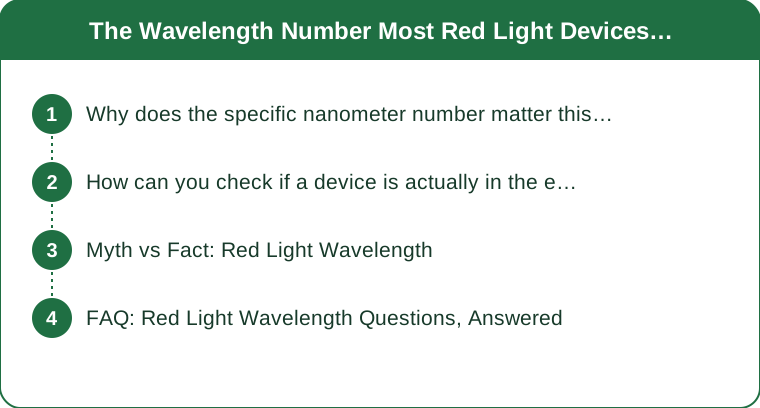
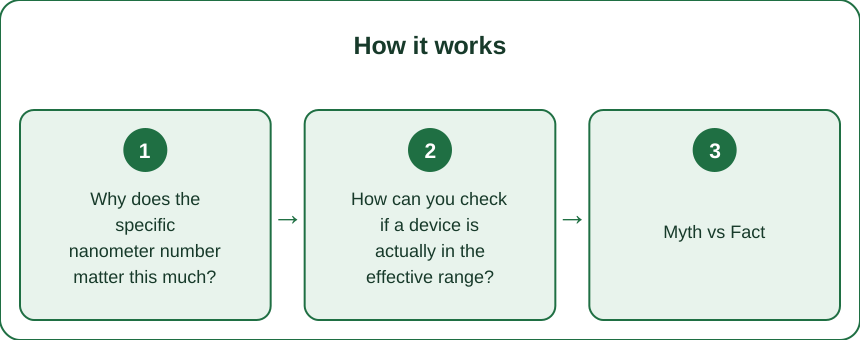
Why does the specific nanometer number matter this much?
Red light therapy works because specific wavelengths are absorbed by mitochondria in a way that stimulates cellular energy production — this is a narrow biological window, not a general “red light is red light” effect. A wavelength outside the studied ranges can look identical to the eye while doing essentially nothing at the cellular level, which is why the nm spec matters more than how red the light appears.
How can you check if a device is actually in the effective range?
Look for the wavelength listed in the product specs, not just marketing copy — a legitimate device will state something like “660nm and 850nm” explicitly. If a listing only says “red light therapy” or “LED therapy” without a nanometer number anywhere in the description or manual, that’s a signal to look elsewhere or ask before buying.

Myth vs Fact: Red Light Wavelength
Myth: any red-colored LED light provides therapy benefits. Fact: only specific wavelength ranges have research support — a red LED bulb from a hardware store is not equivalent. Myth: near-infrared and red light do the same thing. Fact: red light (630-660nm) is studied mainly for skin-level effects, while near-infrared (810-850nm) penetrates deeper for muscle and joint use — a device combining both covers more use cases than one wavelength alone.
FAQ: Red Light Wavelength Questions, Answered
Is a higher nanometer number always better?
No — higher isn’t better or worse, it targets a different depth. Red (630-660nm) works well for skin surface goals, near-infrared (810-850nm) for deeper muscle and joint goals, and many people benefit from a device offering both.
Do cheap red light masks or wands typically list accurate wavelengths?
Some do and some don’t — checking for a specific nm range in the actual spec sheet, not just marketing language, is the most reliable way to tell regardless of price point.
Can a wavelength slightly outside the ideal range still do anything?
Possibly to a lesser degree, but the research support drops off meaningfully outside the roughly 600-880nm window most studies test within.
TL;DR:
- Effective red light therapy sits in specific ranges: ~630-660nm (red) and ~810-850nm (near-infrared)
- A device without a listed nanometer spec may not deliver a measurable effect regardless of how red it looks
- Red light and near-infrared target different depths — skin surface vs deeper tissue
- Check the actual spec sheet for nm numbers before buying, not just the marketing description
The color you see and the wavelength doing the work are two different things — only one of them is checkable before you buy.
Keep Reading
This article is for general informational purposes only and is not medical advice. Always consult a qualified health professional for guidance specific to you.