Why Red Light Therapy Never Shows Results After a Single Session
Quick Answer: Red light therapy works by stimulating mitochondrial activity, which drives gradual collagen production and cellular repair — a process measured in weeks. Research ties results to consistent use over roughly 4-12 weeks at several sessions per week, not to the length or intensity of any single session. Checking after one session is checking on the wrong timescale.
You bought the device. You did your first ten-minute session. You went straight to the mirror.
Nothing. Maybe your face is slightly warm. Possibly a bit pink, which you’re now examining from three angles under the bathroom light while deciding whether you’ve been scammed.
You haven’t, necessarily. You’re just checking a weeks-long process after ten minutes — which is a bit like weighing yourself halfway through a salad.
What Is Red Light Therapy Actually Doing?
Not warming your skin. Not doing anything at the surface at all, really.
Red and near-infrared light penetrates into the skin and is absorbed by mitochondria — the structures inside your cells that produce energy. The current understanding is that this absorption increases cellular energy production, which in turn supports processes like collagen synthesis and tissue repair.
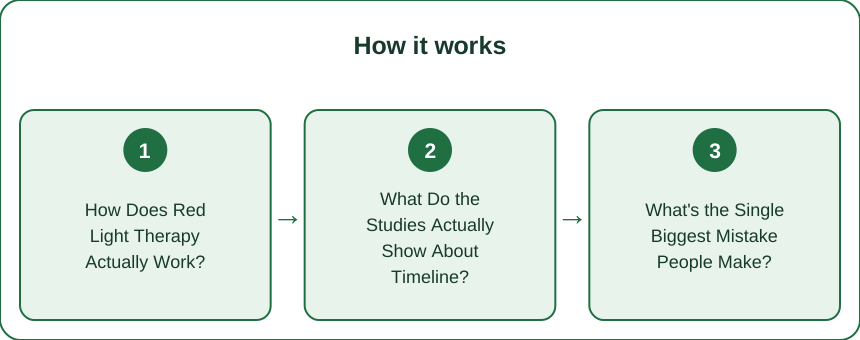
Note what’s in that chain. Light → mitochondria → cellular energy → collagen production → visible change in skin over time.
Every step after the first one is a biological process operating on its own schedule, and none of them are fast. There’s no mechanism in that sequence capable of producing a visible surface result within one session, because the visible result is four steps downstream of what the light actually does.
The warmth and pinkness some people notice afterward is largely blood flow, and it fades within the hour. It’s not the effect; it’s a side note.
Why Can’t a Single Session Deliver Results?
Because collagen doesn’t work on your schedule.
Collagen synthesis and cellular repair unfold over days and weeks. Your body remodels tissue continuously and gradually — new collagen gets laid down, organized and matured over an extended period. That’s simply how the tissue works, and no amount of light shortens it.
Which means no single session can meaningfully complete the process, regardless of device quality or how long you sit there. A longer session doesn’t compress the timeline; a more powerful device doesn’t either. You can’t accelerate collagen by asking harder.
This is also why the “more is better” instinct backfires. Doubling your session length doesn’t double the result, and there’s evidence in this area of a biphasic dose response — where too much light can be less effective than a moderate amount. The recommended settings aren’t manufacturer caution; they’re roughly where the useful window sits.
What’s the Realistic Timeline?
Research on red light therapy consistently ties outcomes to consistent use over roughly four to twelve weeks, at several sessions per week — not to the intensity or duration of any individual session.
A rough expectation map:
- Weeks 1-2: Nothing visible. Possibly better skin feel or hydration, which is mostly circulation. Do not judge anything yet.
- Weeks 3-4: Some people notice texture or tone changes. Subtle.
- Weeks 6-8: The window where most reported changes start appearing.
- Weeks 8-12: Where the studied outcomes generally land.
Consistency beats intensity here more than in almost any other treatment category. Five short sessions a week for two months does considerably more than two long sessions a week, or one heroic session followed by three weeks of the device sitting in a drawer.
And a point people find genuinely annoying: the results aren’t permanent. They depend on continued use. Stop, and the effect gradually fades over months. It’s maintenance, not a course you complete.
What Nobody Tells You About Red Light Devices
Treat it like a skincare active, not a treatment. Nobody expects retinol to work in one night. Red light deserves the same mental model — a slow-acting ingredient in a routine, not a procedure with an immediate result.
Track with photos, not mirrors. Gradual change is genuinely invisible day to day, because your reference point updates continuously. Take a photo at week 0 and then every three weeks, in the same spot, same light, same time of day, no makeup. That’s the only reliable way to know whether it’s doing anything.
Consistency is the variable most people fail on. Most disappointment with red light devices comes from sporadic use, not from the device. A five-minute session attached to an existing daily habit beats an ambitious twenty-minute plan you abandon in week two.
Device specifications matter and are hard to verify. Wavelength and power delivered at the treatment distance are what determine dose, and marketing numbers are frequently optimistic. Distance in particular matters a lot — the light falls off quickly, so sitting further back than instructed meaningfully reduces what you receive.
Eye protection is worth taking seriously, particularly with high-powered panels. Follow the manufacturer’s guidance rather than deciding you’ll just squint.
It won’t do what a procedure does. Red light therapy is a gradual, modest intervention. Comparing it to a clinical laser or injectable treatment sets it up to fail — different mechanisms, different magnitudes, different price brackets.
A note on balance, and when to see a professional: the research here is genuinely promising and genuinely ongoing, with variation in study quality and in how much the results generalize to consumer devices used at home. Talk to a doctor or dermatologist before using red light therapy if you’re pregnant, take medication that increases light sensitivity (some antibiotics, acne medications and others do), have a history of skin cancer, or have an eye condition. See a dermatologist rather than a device for any new, changing or non-healing skin lesion, and stop and get advice if you develop irritation, burning or a rash.
FAQ
How long does red light therapy take to show results?
Most research points to four to twelve weeks of consistent use at several sessions per week before meaningful visible change. Some people notice texture differences around weeks 3-4, but the studied outcomes generally sit closer to the eight-to-twelve week mark.
Is longer or more frequent better with red light therapy?
Neither, past a point. There’s evidence of a biphasic dose response, meaning too much light can be less effective than a moderate amount, so following the device’s recommended session length and distance is the sensible approach. Frequency matters more than duration — several short sessions a week beats occasional long ones.
Do the results of red light therapy last if you stop?
They fade gradually over months. The effect depends on ongoing cellular stimulation, so it’s better understood as maintenance than as a completed course — which is worth knowing before you commit to a device.
TL;DR
- The mechanism is mitochondrial, four steps upstream of anything you can see.
- Collagen synthesis takes days to weeks. No session length or device power shortens that.
- 4-12 weeks, several sessions weekly is where the research puts the results.
- More isn’t better — dose response is biphasic; follow recommended time and distance.
- Track with photos every three weeks, same light, same angle. Mirrors can’t see gradual change.
- Results fade if you stop. It’s maintenance, not a course. And skip it if you’re on light-sensitizing medication without asking a doctor.
Keep Reading
This article is for general informational purposes only and is not medical advice. Always consult a qualified health professional for guidance specific to you.